
Freeing an object in your app's code or closing a temporary stream doesn't always return physical RAM to the operating system. Custom native allocators, garbage-collected runtimes, and open-addressed hash tables frequently retain virtual memory arenas that stay backed by physical pages long after the logical data inside them is gone. Similarly, reading or memory-mapping large asset archives populates the kernel page cache, which remains charged to your app's memory control group (memcg).
This page explains how to use the madvise and posix_fadvise system calls to
return unused anonymous and file-backed pages to the OS while keeping virtual
address reservations and file descriptors intact, and how to verify the impact
in adb shell and Perfetto.
Why logical deallocation retains physical RAM
The Linux kernel tracks physical memory at the granularity of hardware pages,
which are 4 KB or 16 KB on Android devices. When a
process reserves a region of virtual address space with mmap, the kernel
creates a virtual memory area (VMA) without allocating physical RAM. The kernel
allocates and charges a physical page only when the process first touches that
page. For anonymous memory, a first read maps a shared zero page, so only a
write allocates RAM.
Once a page is faulted into RAM, the kernel doesn't know whether the bytes inside that page still represent live objects in your app's runtime. Two common patterns keep physical pages resident after your app finishes using them:
- Anonymous arenas and pools: Custom native allocators (such as slab,
pool, or frame-arena allocators), managed runtimes with non-moving heap
spaces, and large hash tables reserve contiguous virtual address ranges with
mmapusingMAP_PRIVATE | MAP_ANONYMOUS. When your app resets an arena, frees a block back to a custom pool, or clears a hash table by zeroing its metadata, the underlying pages remain dirty. Without an explicit hint to the kernel, those pages continue to count toward your process's anonymous resident set size (RSS) and proportional set size (PSS) and itsmemory.currentcgroup charge. Under memory pressure, the kernel compresses them into ZRAM, where they still occupy swap space charged tomemory.swap.current. - File-backed page cache from asset streaming: When your app reads large
asset bundles, level archives, media containers, or machine learning models
using
read,pread, or file-backedmmap, the kernel caches every read page in the page cache and charges those pages to thefilecounter in thememory.statfile of your process's cgroup. If your app decompresses or copies that asset into an anonymous runtime buffer or uploads it to the GPU, keeping the raw file pages in the page cache duplicates the asset in RAM.
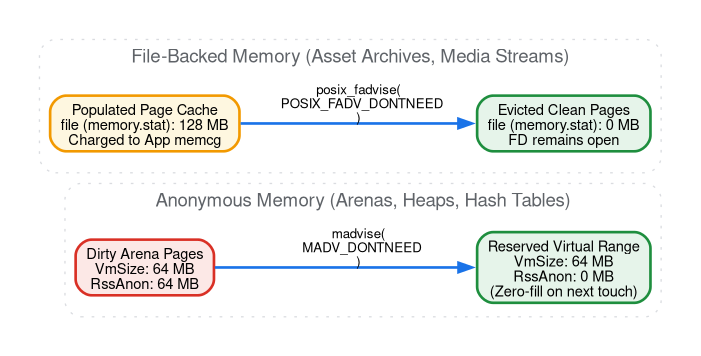
Release anonymous pages
The madvise system call gives the kernel advice about how your process expects
to use a virtual address range. For private anonymous mappings (MAP_PRIVATE |
MAP_ANONYMOUS), passing MADV_DONTNEED instructs the kernel to immediately
discard the physical pages and any swapped ZRAM entries backing the specified
page-aligned range.
After madvise with MADV_DONTNEED returns:
- The virtual address range remains reserved and valid in your process's
address space (
VmSizedoesn't change), so pointers and arena bounds stay intact without callingmunmapormmap. - The physical pages are immediately unmapped and freed, reducing
RssAnon,Pss, theanoncounter inmemory.stat, andmemory.swap.currentfor any pages that were in ZRAM. - Any subsequent read or write to an address in that range faults in a fresh zero-filled page on demand.
| Advice flag | Target mapping | Kernel behavior on Android |
|---|---|---|
MADV_DONTNEED |
Private anonymous (MAP_PRIVATE | MAP_ANONYMOUS) |
Immediately discards physical pages and ZRAM swap slots. Subsequent
accesses fault in zero-filled pages. Deterministic drop in
RssAnon and memory.current. |
MADV_DONTNEED |
File-backed (MAP_PRIVATE or MAP_SHARED) |
Unmaps pages from the process page tables (RssFile
drops). Private copy-on-write pages in a MAP_PRIVATE mapping
are discarded, so modifications are lost and the next access rereads the
file. Dirty MAP_SHARED pages are written back to storage
later. Clean pages stay in the page cache until they're evicted. |
MADV_FREE |
Private anonymous (MAP_PRIVATE | MAP_ANONYMOUS) |
Marks pages as lazily reusable. The kernel retains the pages in
RssAnon if no memory pressure exists and reclaims them only
when global or memcg reclaim runs. |
MADV_WILLNEED |
File-backed or swapped anonymous | Starts asynchronous readahead for file-backed mappings, or reads swapped anonymous pages back from ZRAM into the swap cache ahead of time. |
Align interior ranges to the runtime page size
madvise operates on whole pages. It requires a page-aligned start address and
rounds the length up to the next page boundary. If you release a span inside a
shared arena where neighboring bytes still hold live objects, rounding the range
outward can zero out live allocations that share the boundary pages.
Always query the runtime page size with sysconf(_SC_PAGESIZE) to support both
4 KB and 16 KB page devices, and round the interior start address
up to the next page boundary and the interior end address down to the
previous page boundary. For more guidance on page-size-agnostic allocators, see
Optimize custom memory allocators.
#include <sys/mman.h>
#include <unistd.h>
#include <cstdint>
// Reclaims physical pages strictly inside [region_start, region_start + length)
// without disturbing live objects on partially occupied boundary pages.
void ReleaseUnusedArenaSpan(void* region_start, size_t length) {
const uintptr_t page_size = static_cast<uintptr_t>(sysconf(_SC_PAGESIZE));
const uintptr_t page_mask = ~(page_size - 1);
const uintptr_t raw_start = reinterpret_cast<uintptr_t>(region_start);
const uintptr_t raw_end = raw_start + length;
// Round start UP and end DOWN so only fully unused pages are discarded.
const uintptr_t aligned_start = (raw_start + page_size - 1) & page_mask;
const uintptr_t aligned_end = raw_end & page_mask;
if (aligned_end > aligned_start) {
madvise(reinterpret_cast<void*>(aligned_start),
aligned_end - aligned_start,
MADV_DONTNEED);
}
}
When creating custom anonymous mappings with mmap, label the VMA with prctl
using PR_SET_VMA_ANON_NAME so that you can track its residency by name in
showmap and /proc/<pid>/smaps. dumpsys
meminfo counts custom-named anonymous regions under Unknown.
Some older kernels keep a pointer to the name instead of copying it, so pass a
string that stays valid for the lifetime of the mapping, such as a string
literal:
#include <sys/mman.h>
#include <sys/prctl.h>
#ifndef PR_SET_VMA
#define PR_SET_VMA 0x53564d41
#define PR_SET_VMA_ANON_NAME 0
#endif
void* ReserveNamedArena(size_t capacity_bytes, const char* arena_name) {
void* ptr = mmap(nullptr, capacity_bytes, PROT_READ | PROT_WRITE,
MAP_PRIVATE | MAP_ANONYMOUS, -1, 0);
if (ptr != MAP_FAILED) {
prctl(PR_SET_VMA, PR_SET_VMA_ANON_NAME,
reinterpret_cast<unsigned long>(ptr), capacity_bytes,
reinterpret_cast<unsigned long>(arena_name));
}
return ptr;
}
Evict file cache pages
When your app reads data from a file descriptor, the kernel caches the file's pages in the page cache in anticipation of future reads. While this speeds up repeated accesses to small configuration files or shared libraries, it works against you when streaming large asset archives, texture packages, or audio and video chunks that are parsed once and stored in decoded form elsewhere.
The posix_fadvise system call lets your app inform the kernel about its
expected file access pattern on an open file descriptor:
POSIX_FADV_DONTNEED: Instructs the kernel that the specified byte range won't be accessed in the near future. The kernel immediately evicts clean, unmapped cached pages in that page-aligned range from the page cache, reducing thefilecounter inmemory.statand thememory.currentcharge of your cgroup.POSIX_FADV_SEQUENTIAL: Doubles the kernel's readahead window for the file descriptor, improving throughput when streaming a large archive from start to finish. Pair this withPOSIX_FADV_DONTNEEDon trailing chunks as you consume them so the page cache footprint stays bounded to a small sliding window.POSIX_FADV_RANDOM: Disables speculative kernel readahead on the file descriptor. Use this when performing sparse, non-contiguous lookups by byte offset into a large archive or database file so that each small read doesn't pull adjacent unused pages into the page cache. For memory-mapped files, callmadvisewithMADV_RANDOMon the mapping instead.
The following example streams a large asset archive in chunks, enabling sequential readahead upfront and evicting each processed page-aligned span from the page cache:
#include <fcntl.h>
#include <unistd.h>
#include <cstdint>
#include <vector>

void StreamAssetArchive(int fd, size_t total_size) {
  const size_t page_size = static_cast<size_t>(sysconf(_SC_PAGESIZE));
  constexpr size_t kChunkSize = 4 * 1024 * 1024;  // 4 MB streaming window
  std::vector<uint8_t> buffer(kChunkSize);

  // Hint sequential access so the kernel prefetches upcoming chunks.
  posix_fadvise(fd, 0, total_size, POSIX_FADV_SEQUENTIAL);

  off_t offset = 0;
  while (offset < static_cast<off_t>(total_size)) {
    ssize_t bytes_read = pread(fd, buffer.data(), buffer.size(), offset);
    if (bytes_read <= 0) break;

    // Decode or upload buffer[0 .. bytes_read) into runtime structures here.

    // Evict full pages that have been completely consumed.
    const size_t aligned_len =
        (static_cast<size_t>(bytes_read) / page_size) * page_size;
    if (aligned_len > 0) {
      posix_fadvise(fd, offset, static_cast<off_t>(aligned_len),
                    POSIX_FADV_DONTNEED);
    }
    offset += bytes_read;
  }
}
Reclaim file-backed mmap regions
If your app memory-maps a large asset file with mmap instead of reading it
with pread, calling posix_fadvise with POSIX_FADV_DONTNEED alone doesn't
evict pages that are still mapped into your process's page tables. To drop a
consumed span of a read-only file mapping without unmapping the entire VMA:
- Call
madvise(addr, length, MADV_DONTNEED)on the mapped virtual address range to unmap those pages from your process's page tables (RssFiledrops). - Call
posix_fadvise(fd, offset, length, POSIX_FADV_DONTNEED)on the corresponding file offset so the kernel also evicts the unmapped clean pages from the page cache (fileinmemory.statdrops).
Follow page advice guidelines
Apply these practices when integrating madvise and posix_fadvise into
allocators, asset loaders, and lifecycle handlers:
- Batch calls into coarse regions: Each
madvisecall takes your process's memory map lock (mmap_lock), walks page tables, and invalidates the matching translation lookaside buffer (TLB) entries on other CPU cores (with broadcast TLB maintenance instructions on Arm and inter-processor interrupts on x86). Don't callmadviseon every small deallocation. Coalesce free spans and advise the kernel in chunks of 64 KB to 1 MB or larger, or sweep free spans during frame boundaries and background transitions (onStopandTRIM_MEMORY_UI_HIDDEN). - Reclaim empty capacity in hash tables and pools: When a large hash
table, object pool, or staging buffer is cleared after a scene transition or
data sync, either shrink its backing allocation or issue
MADV_DONTNEEDacross the cleared backing array. Keeping a 32 MB open-addressed table allocated with tombstones keeps all 32 MB of physical pages charged to your process. - Flush dirty file data before evicting it:
POSIX_FADV_DONTNEEDonly evicts clean page cache pages. If your app writes a large temporary or cache file that it won't read back immediately, callfdatasyncbeforeposix_fadvise(fd, 0, 0, POSIX_FADV_DONTNEED)so the dirty pages are written to storage and then dropped from RAM. - Don't evict hot shared code or assets: Avoid calling
POSIX_FADV_DONTNEEDon DEX, ODEX, VDEX, shared libraries (.so), or UI assets that are accessed repeatedly. Evicting active code or asset pages forces synchronous storage refaults that stall threads and raise I/O pressure, as reported by pressure stall information (PSI).
Verify page reclamation in the shell
Verify that madvise and posix_fadvise reclaim physical RAM using showmap
and your app's cgroup v2 accounting files.
Inspect virtual versus physical size with showmap
When you name an anonymous arena with PR_SET_VMA_ANON_NAME, showmap displays
both its virtual reservation (virtual size) and its resident physical pages
(RSS and PSS). The following sample output comes from the MemoryLab sample
app in AOSP, which names its arena memorylab-arena. Replace com.example.app
and memorylab-arena with your package name and arena name. Before calling
madvise with MADV_DONTNEED on a touched 64 MB arena, run:
adb shell "showmap \$(pidof com.example.app) | grep -E '^ +virtual|^ +size|memorylab-arena' | head -3"
 virtual                     shared   shared  private  private                   Anon      Shmem     File      Shared   Private
    size      RSS      PSS    clean    dirty    clean    dirty     swap  swapPSS HugePages PmdMapped PmdMapped Hugetlb  Hugetlb    Locked    # object
   65536    65536    65536        0        0        0    65536        0        0         0         0         0        0        0        0    1 [anon:memorylab-arena]
After calling madvise(arena_ptr, 64 * 1024 * 1024, MADV_DONTNEED), run
showmap again:
 virtual                     shared   shared  private  private                   Anon      Shmem     File      Shared   Private
    size      RSS      PSS    clean    dirty    clean    dirty     swap  swapPSS HugePages PmdMapped PmdMapped Hugetlb  Hugetlb    Locked    # object
   65536        0        0        0        0        0        0        0        0         0         0         0        0        0        0    1 [anon:memorylab-arena]
The virtual size stays at 65536 KB (64 MB), confirming that the
virtual address range is still reserved, while RSS, PSS, and private dirty
drop to 0 KB.
Inspect cgroup memory.current and memory.stat
To verify both anonymous page reclamation and unmapped page cache eviction
(which doesn't appear in process page tables if read with pread), inspect the
process's cgroup v2 directory. On Android, each app process has its own cgroup
(such as /sys/fs/cgroup/apps/uid_<UID>/pid_<PID>/, depending on the device).
The following command finds the directory from the 0:: line of
/proc/<PID>/cgroup and prints the counters:
adb shell '
  PID=$(pidof com.example.app)
  CG=/sys/fs/cgroup$(sed -n "s/^0:://p" /proc/$PID/cgroup)
  echo "memory.current: $(cat $CG/memory.current)"
  echo "memory.swap.current: $(cat $CG/memory.swap.current)"
  grep -E "^(anon|file) " $CG/memory.stat
'
Before releasing a 64 MB anonymous arena and evicting a 128 MB memory-mapped asset file from the page cache:
memory.current: 242962432
memory.swap.current: 16633856
anon 100671488
file 140009472
Immediately after calling madvise with MADV_DONTNEED on the arena and on
the asset file mapping, and then posix_fadvise with POSIX_FADV_DONTNEED on
the asset file descriptor:
memory.current: 41766912
memory.swap.current: 16502784
anon 33722368
file 5914624
anon drops by 64 MB and file drops by 128 MB, reducing
memory.current by about 192 MB without closing the file descriptor or
unmapping the arena's virtual address space. memory.swap.current barely
changes, because almost none of the arena pages had been swapped to ZRAM. Your
values depend on the device and on how much of the file the kernel already
evicted on its own. For more about how the kernel charges and reclaims
memory per cgroup, see Memory reclaim: eviction and swap.
Analyze page reclamation in Perfetto
Perfetto lets you correlate madvise and posix_fadvise calls with kernel
page-table and page-cache counters on a unified timeline.
Record a trace
Capture a trace with linux.process_stats for periodic process counters and
linux.ftrace for real-time RSS and page-cache events, and then pull it to
your computer:
adb shell perfetto -c - --txt -o /data/misc/perfetto-traces/page_advice.perfetto-trace <<EOF
buffers: {
    size_kb: 65536
    fill_policy: RING_BUFFER
}
data_sources: {
    config {
        name: "linux.process_stats"
        process_stats_config {
            scan_all_processes_on_start: true
            proc_stats_poll_ms: 100
        }
    }
}
data_sources: {
    config {
        name: "linux.ftrace"
        ftrace_config {
            ftrace_events: "kmem/rss_stat"
            ftrace_events: "filemap/mm_filemap_add_to_page_cache"
            ftrace_events: "filemap/mm_filemap_delete_from_page_cache"
        }
    }
}
duration_ms: 20000
EOF
adb pull /data/misc/perfetto-traces/page_advice.perfetto-trace
Inspect tracks in the Perfetto UI
Open the trace in the Perfetto UI, expand your app's process group, and pin the following counter tracks so they stay at the top of the timeline:
mem.virt: Remains flat acrossMADV_DONTNEEDcalls, confirming that the virtual address reservation (mmap) is unchanged.mem.rss.anon: Steps down sharply at the exact timestamp where your app callsmadvisewithMADV_DONTNEEDon dirty anonymous arenas or heap regions.mem.rss.file: Steps down when your app callsmadvisewithMADV_DONTNEEDon a file-backedmmapregion, accompanied by a burst ofmm_filemap_delete_from_page_cacheftrace events whenposix_fadvisewithPOSIX_FADV_DONTNEEDevicts the clean pages from the page cache.mem.swap: Drops whenMADV_DONTNEEDdiscards anonymous pages that had previously been compressed into ZRAM.
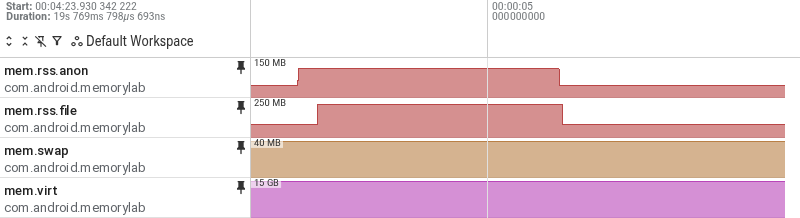
Figure 2 shows these tracks for the MemoryLab sample app. To explore the same view, open the sample trace in the Perfetto UI.
Query peak and final memory with PerfettoSQL
Run the following PerfettoSQL query in the Perfetto UI (Query (SQL) tab) to
compare the peak and final values of mem.virt, mem.rss.anon,
mem.rss.file, and mem.swap for your target process:
WITH counters AS (
  SELECT t.name AS counter_name, c.ts, c.value
  FROM counter c
  JOIN process_counter_track t ON c.track_id = t.id
  JOIN process p USING (upid)
  WHERE p.name = 'com.example.app'
    AND t.name IN ('mem.virt', 'mem.rss.anon', 'mem.rss.file', 'mem.swap')
)
SELECT
  counter_name,
  CAST(MAX(value) / 1048576 AS INT) AS peak_mb,
  CAST((
    SELECT value FROM counters AS last
    WHERE last.counter_name = counters.counter_name
    ORDER BY ts DESC LIMIT 1
  ) / 1048576 AS INT) AS final_mb
FROM counters
GROUP BY counter_name
ORDER BY counter_name;
Sample output for the trace in Figure 2:
counter_name  peak_mb  final_mb
mem.rss.anon      111        48
mem.rss.file      212        84
mem.swap           36        36
mem.virt        13952     13952
mem.rss.anon drops by 63 MB and mem.rss.file drops by 128 MB from
their peaks, while mem.virt ends at its peak because the virtual
reservations are unchanged.
Resolve evicted pages to files
The mm_filemap_add_to_page_cache and mm_filemap_delete_from_page_cache
events identify files by inode number (i_ino) rather than by path. To confirm
that the evicted pages belong to the file you advised, count the evictions per
inode:
SELECT
  EXTRACT_ARG(arg_set_id, 'i_ino') AS inode,
  COUNT(*) AS evicted_pages
FROM ftrace_event
WHERE name = 'mm_filemap_delete_from_page_cache'
GROUP BY inode
ORDER BY evicted_pages DESC
LIMIT 5;
Sample output for the trace in Figure 2:
inode     evicted_pages
9761              35781
76792192            767
126                 668
0                   612
11587712            514
While the device that recorded the trace is still connected, resolve each inode to a path. Inode numbers are unique only within one file system, so limit the search to the file system that holds your app's data:
INODE=<inode from the query>
adb shell "find /data -xdev -inum $INODE 2>/dev/null"
Sample output for inode 9761:
/data/user/0/com.android.memorylab/files/asset_pack.bin
/data/data/com.android.memorylab/files/asset_pack.bin
Both paths refer to the same file, because /data/user/0 and /data/data are
two names for the same app data directory. The eviction count for the asset
file (35,781 pages) is larger than the file itself (32,768 pages at
4 KB), because kswapd had already evicted part of the file under memory
pressure before the app read it back and called posix_fadvise.
For a script that resolves many inodes at once, see Resolving faults to inodes, then to files.
← kswapd and lmkd interaction | ↑ Up | Lean background process →