
You should be testing your integration throughout development. To test during the development phase, we recommend leveraging license testers and Play Billing Lab to run through the scenarios described in this section.
License Testers
To configure license testers, see Test in-app billing with application licensing.
Using license testers provide the following benefits:
- Ordinarily, the Google Play Billing Library is blocked for apps that aren't signed and uploaded to Google Play. License testers can bypass this check, meaning you can sideload apps for testing, even for apps using debug builds with debug signatures without the need to upload to the new version of your app. Note that the package name must match that of the app that is configured for Google Play, and the Google Account must be a license tester for the Google Play Console account.
- License testers have access to test payment methods that avoid charging the testers real money for purchases. You can also use test payment methods to simulate certain situations, such as when a payment is declined. Figure 1 shows these test forms of payment as they appear within the purchase flow.
- License testers can rapidly test subscription features.

Here are some additional details about the test purchase process:
- Test purchases use the same app purchase flow used by actual purchases.
- Taxes are not computed for test purchases.
- Google Play indicates a test purchase by displaying a notice across the center of the purchase dialog.
You can confirm the account that is making a purchase by expanding the purchase dialog. Note the following:
- Test accounts must be on the tester's Android-powered device.
- If the device has more than one account, the purchase is made with the account that downloaded the app.
- If none of the accounts have downloaded the app, the purchase is made with the first account.
Use Google Play test tracks for pre-distribution validation, such as allowing your QA team to qualify new releases. With test tracks, license testers can install and evaluate unreleased versions of your app from Google Play. Regular users can make real purchases using standard payment methods.
To test your Google Play Billing Library integration using test tracks, do the following:
- Publish your app to a test track. Note that after you publish an app to a testing track, it can take a few hours for the app to be available for testers.
- Ensure each tester opts-in to your app's test. On your test's opt-in URL, your testers see an explanation of what it means to be a tester along with a link to opt-in.
You can test your integration on any Android-powered hardware device running Android 1.6 or higher. The most current version of the Google Play application must be installed on the device. For general information about how to set up a device for use in developing Android applications, see Using Hardware Devices.
Play Billing Lab
Play Billing Lab is an Android app that helps developers test their integration with Google Play's billing system. It provides a convenient way for developers to test billing features, integrate faster, and launch with higher confidence. You can download and install Play Billing Lab from the Play Store.
Play Billing Lab lets you to do the following in your testing:
- Change Play Country from within Play Billing Lab and apply the settings to your test. This enables testing custom user-experiences in different countries/regions regardless of where the tester is physically testing
- Test trial or introductory offers repeatedly with the same account
- Test subscription price changes without affecting other active subscribers
- Accelerate subscription state transition to accelerate subscription renewals, or move your test subscription into grace period or account hold state with one click to speed up your testing
- Test with real payment methods to bypass certain purchase flow risk signals
- Test out-of-app purchases to make sure that your backend can handle them

Test one-time products
Test consumable products
When testing consumable products, test a variety of situations, including the following:
- A successful purchase where the user receives an item. With a license tester, you can use the Test instrument, always approves payment method.
- A purchase where the payment method failed to be charged, and the user shouldn't receive the item. With a license tester you can use the Test instrument, always declines payment method.
- Ensure items can be purchased multiple times.
Verify that purchases are properly acknowledged as described in processing purchases. For purchases from license testers, a purchase will be refunded after 3 minutes if your app does not acknowledge the purchase and you will receive an email about the cancellation. You can also check the Orders tab in the Google Play Console to see if an order was refunded after 3 minutes.
Test non-consumable products
Non-consumables should be tested the same as consumables, but you should verify an item cannot be purchased again within your app. Be sure to verify purchase acknowledgement for both non-consumables and consumables (when applicable) since the logic to process each the two types of purchases vary.
Test pending purchases
Test a pending purchase where the item should be granted when the purchase state
becomes PURCHASED. License testers have access to two test instruments for
delayed forms of payment where the payment automatically completes or cancels
after a couple of minutes.
Make a purchase with a delayed form of payment Slow test card, declines after a few minutes, as shown in figure 3. Restart the app, validate that the purchase has not been granted.
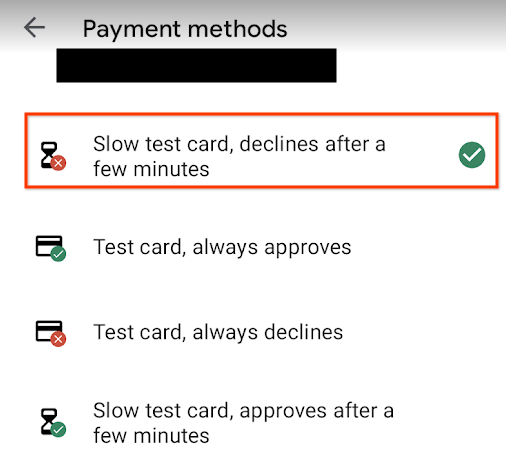
Figure 3. Test a purchase with a declined slow test card. Make a purchase with a delayed form of payment Slow test card, approves after a few minutes, as shown in figure 4. Wait a few minutes, validate that the purchase has been granted.

Figure 4. Test a purchase with an approved slow test card.
You can find more information at Handling pending transactions.
Test user-initiated chargebacks
License testers have access to a test instrument that lets them simulate a user-initiated chargeback.
Make a purchase with the test instrument Test card, approves then charges back, as shown in figure 5. Soon afterwards, your system should be made aware of the test purchase being delivered and charged back through applicable surfaces. For example, you should receive a PendingRefundReviewNotification moments after making the purchase.

Figure 5. Test a purchase with a test card that approves then charges back.
Test subscription-specific features
The purchase flows for one-time products and subscriptions are similar, but subscriptions have additional scenarios, such as successful or declined subscription renewals. To test renewals, you can use the Test card, always approves and Test card, always declines payment methods that are available for license testers, as shown in figure 1. Use these payment instruments to test scenarios beyond the successful subscription scenario.
Similar to one-time products, verify that purchases are properly acknowledged as described in processing purchases. For purchases from license testers, a purchase is refunded after 3 minutes if your app does not acknowledge the purchase, and you receive an email about the cancellation. You can also check the Orders tab in Google Play Console to see if an order was refunded after 3 minutes.
Renewal periods
Test subscriptions renew more quickly than actual subscriptions, and test subscriptions can renew a maximum of six times, not counting free trials and introductory periods.
The following table lists the testing renewal times for subscriptions of various durations. These times are approximate. You may see small variations in the precise time of an event. To compensate for variation, call the API to view the current status after every subscription expiration date.
| Production subscription period | Test subscription renewal |
| 1 week | 5 minutes |
| 1 month | 5 minutes |
| 3 months | 10 minutes |
| 6 months | 15 minutes |
| 1 year | 30 minutes |
Time-based subscription features such as free trials are also shortened for testing. The following table identifies the testing time periods associated with time-based subscription features:
| Feature | Test period |
| Account hold | 10 minutes |
| Free trial | 3 minutes |
| Grace period | 5 minutes |
| Introductory price period | Same as subscription test period |
| Pause (1 month) | 5 minutes |
| Pause (2 months) | 10 minutes |
| Pause (3 months) | 15 minutes |
| Price step-up consent period (applicable only for the South Korea (KR) region) |
3 minutes |
| Purchase acknowledgement | 5 minutes |
Accelerate subscription state transition
You can also use Play Billing Lab and license testers to accelerate the test subscriptions renewal periods to speed up your subscription testing or move the test subscription to grace period or account hold state to test payment decline scenarios with the following steps:
- Click Manage on the Subscription settings card in the Dashboard.
- Choose the active subscription you want to test.
- Click the Subscription state drop-down menu.
- Click the target state to update the subscription state.

Once you've selected the target subscription state in the drop-down menu, the test subscription state will update shortly afterward.
Note that:
- Test subscriptions must be acknowledged before using the Accelerate Subscription State Transition feature.
- Your payment method will automatically decline when you move the test subscription to grace period or account hold state. When you restore the test subscription, your payment method will restore to automatic approval.
- The subscription state transition process might take a few seconds to execute.
- When the subscription state transition is in progress, the subscription price change feature is not available.
- If you renew the test subscription when a price change is in effect, Play applies the new price if the user has accepted it. However, if the new price requires user acceptance and the user hasn't agreed to it yet, Play cancels the subscription.
Trial Offers
With the Play Billing Lab trial offer testing feature, a license tester can test and use free trial or introductory offers an unlimited number of times by checking the Test free trial or introductory offer checkbox and applying the change. This removes the need to create multiple accounts to test a trial offer only available to new subscribers.

Price changes
You can also use Play Billing Lab and license testers to test subscription price changes without affecting other active subscribers with the following steps:
- Click Manage on the Subscription settings card in the Dashboard.
- Choose the active subscription you want to test.
- Enter the new price.
- Select or unselect the User opt-out checkbox per your test requirement.
- Click Apply.

After applying your changes, the price is updated starting from the next renewal only for the tester. Other active subscribers won't be affected. All the license testers rules apply to the test subscription. The tester can then test their app for downstream processes triggered by the price change, such as price change notifications.
Keep the following considerations in mind when planning test periods:
- Due to a small renewal duration for license testers, it's possible that a price migration made from the console won't register for license testers. To ensure that price change notifications and emails can be tested, developers should defer billing by at least one hour after triggering a price change.
- Price decreases don't have a notification period. Users are notified of a price decrease soon after cohort migration. This is unchanged when testing.
- For price increases, test notification times are calculated the same as with
actual increases:
- The user is first charged at the first billing anniversary following a mandatory notification period.
- Notification times are calculated backward from the first charge date.
- The final notification is always 1 minute before the charge, regardless of billing period.
The following table shows test billing and notification periods for several actual billing periods:
| Actual base plan billing period | Test billing period | Test notification period (opt-in and opt-out regions with 30 day notice) | Test notification period (opt-out regions with 60 day notice) |
| 1 week | 5 minutes | 5 minutes | 10 minutes |
| 1 month | 5 minutes | 5 minutes | 10 minutes |
| 3 months | 10 minutes | 3 minutes | 6 minutes |
| 6 months | 15 minutes | 2 minutes | 4 minutes |
| 1 year | 30 minutes | 3 minutes | 6 minutes |
Price step-up consent
Information related to a price step-up that requires user consent will be
available to you in the purchases.subscriptionsv2.get API.
Google Play sends two push and email price step-up notifications to the relevant users (including license testers) before the step-up is live. The notification period for testing is as follows:
| Notification schedule | Test notification period |
| First notification | 3 minutes |
| Second (final) notification | 1 minute |
Test cases
Expand the following section by clicking Show/Hide to show testing scenarios you should use to verify your subscription integration.
Test pending transactions
You should test pending transactions are handled correctly and entitlements are
updated accordingly when the purchase state becomes PURCHASED. License testers
have access to two test instruments for delayed forms of payment where the
payment automatically completes or cancels after a couple of minutes.
Make a purchase with a delayed form of payment Slow test card, declines after a few minutes, as shown in figure 9. Restart the app, validate that the purchase has not been granted.
Figure 9. Test a purchase with a declined slow test card. Make a purchase with a delayed form of payment Slow test card, approves after a few minutes, as shown in figure 10. Wait a few minutes, validate that the purchase has been granted.
Figure 10. Test a purchase with an approved slow test card.
Test promo codes
You can use the Google Play Console to create codes for your own testing. Keep in mind that you may only create 500 promo codes per quarter across all managed products in an app.
You should test the following promo code redemption scenarios:
- When the promo code is entered in the purchase dialog that was launched within your app.
- When the promo code is redeemed in the Google Play Store app.
- When the promo code is redeemed at https://play.google.com/store using the Redeem button in the left-hand navigation.
Within these scenarios, you should test redeeming codes in as many ways as possible. Perform the following tests at a minimum:
- Redemption before the app is installed.
- Redemption while the app is running in the foreground. Note that for this test, you need another device to test using the Google Play Store app. Be sure to test redemptions from different screens in your app.
- Redemption with multi-window mode, where both your app and the Google Play Store app are being displayed at the same time.
For each test, make sure that the item is correctly detected and that the user is notified.
Test the purchase experience in different regions
You can test the purchase experience in different regions with the Play Billing Lab app. To use the Play Billing Lab, you must be a license tester. Use the following steps to test:
- Register the app billing user as a license tester.
- Log into Play Billing Lab app with the same user.
- Select the required country and apply the change in Play Billing Lab.
Launch the purchase flow in the app under testing.

Figure 11. Test purchase experience in different regions.
Play Billing Lab lets you test offer regional eligibility and the user experience in any region, regardless of where you are physically testing.
Test the purchase experience using real payment methods
You can test the purchase experience with real payment methods with the Play Billing Lab Android app.
Use the following steps to test real payment methods:
- Register the Google Account user as a license tester.
- Log into the Play Billing Lab app with the same user.
- Enable real payment methods in the Play Billing Lab app.
- Restart and launch the purchase flow in the app under testing.
Spend limits for unpublished apps
Apps that are in the draft stage or published to the internal test track, are subject to spend limits.
Google Play enforces limits on the following:
- Daily transactions: The number of transactions a user can make per day across all unpublished apps.
- Per-order value: The maximum amount for an individual transaction.
- Daily total spend: The cumulative daily expenditure for a user across all unpublished apps.
These limits reset every 24 hours.
If a user exceeds any of these limits while testing your app, they will see an error message in the purchase cart, and the transaction will be blocked.
Test out-of-app purchases
Google Play can promote your one-time products and subscriptions on surfaces outside of your app, such as your app's details page in the Play Store and Gemini. You manage these promotions on the Merchandising and optimization page in Google Play Console. Because users can purchase these products without opening your app, your app and backend must be able to detect and deliver out-of-app purchases.
You can use the Play Billing Lab app to test the end-to-end experience for entitlements acquired outside of your app. You don't need to configure merchandising and optimization settings before you test. To use Play Billing Lab, you must be a license tester for the app you are testing.
Step 1 - Configure test
- Register the app billing user as a license tester.
- Open the Play Store and log into it with the same user.
- Open the Play Billing Lab app and log into it with the same user.
- Select the Out-of-app purchases test card.
- Optional: Select your test country and apply the change in Play Billing Lab.
- If you don't select a country, Play Billing Lab uses the Play Country for your licensed test account.
- Enter the app's package name, select the product type (One-time product or Subscription), and enter the product ID (SKU) that you want to test.
- Select the particular purchase option, base plan, or offer that you want to test. Play Billing Lab only shows the offers that your licensed tester account is currently eligible for.
- Click Start test.
Step 2 - Acquire the out-of-app product
- Featured products
- Purchase recommendations (after abandoning a purchase)
- Play Games Rewards
- Agentic commerce (Gemini)
Step 3 - Handle and deliver the entitlement
Your app should detect the out-of-app purchase, and then deliver the item to the respective user. Make sure that your backend receives Real-time developer notifications (RTDN) and acknowledges the purchase. For the full process, see processing purchases.
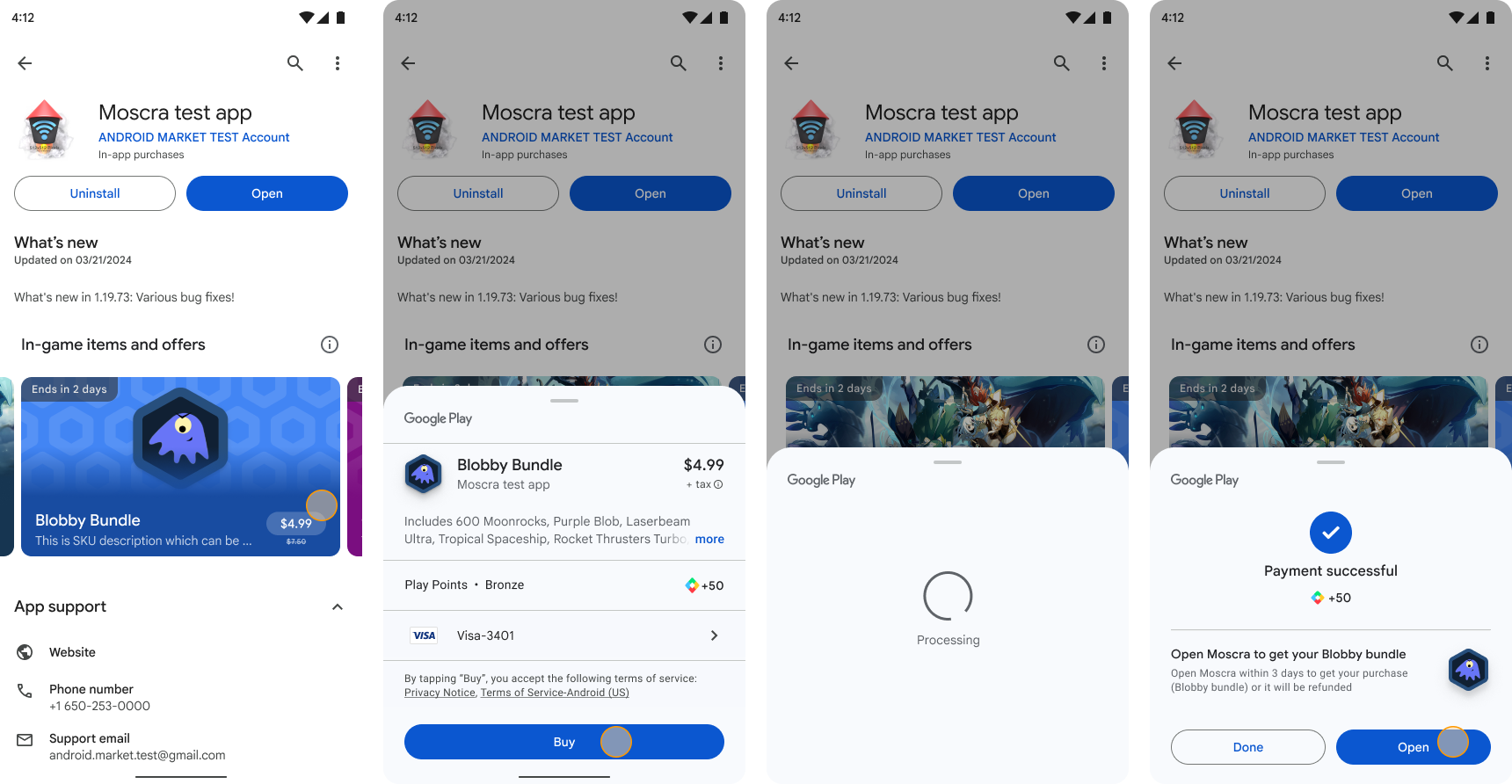
Featured products
- Open the Play Store and sign in with the same licensed tester account that
you used to configure the test in Play Billing Lab.
- If the Play Store was previously open, close and restart it.
- Navigate to the app details page for your app.
- The item is shown on this page.
- Select the item and complete the purchase.
Purchase recommendations
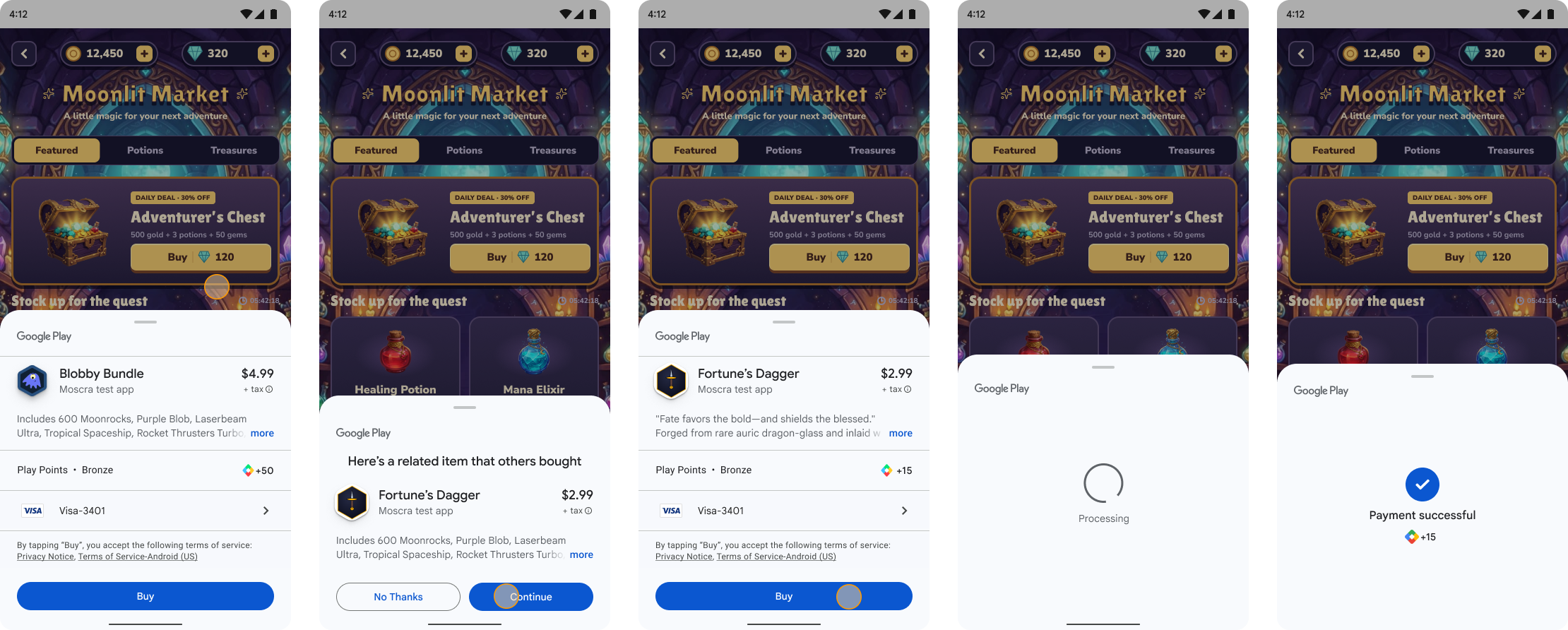
After cart is abandoned:
- Restart your app.
- Initiate a purchase flow for a one-time product in your app.
- Dismiss or abandon the purchase cart dialog without completing the transaction.
- Check for the abandoned cart purchase recommendation.
- Accept the recommendation and complete the purchase.
Play Games Rewards
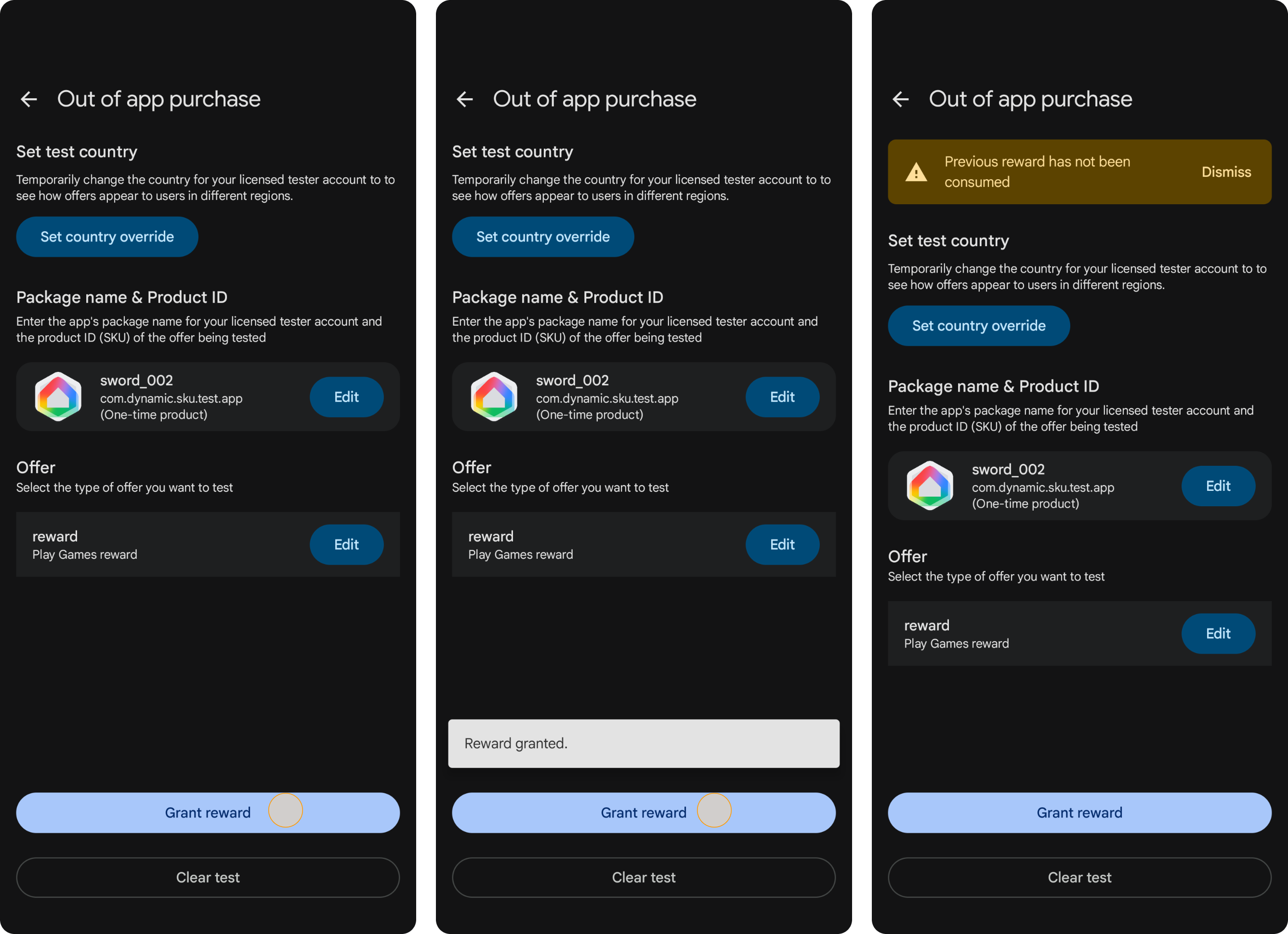
Click Grant Reward to simulate Play granting the reward to the user. Existing rewards must be processed before additional rewards can be granted.
Agentic commerce
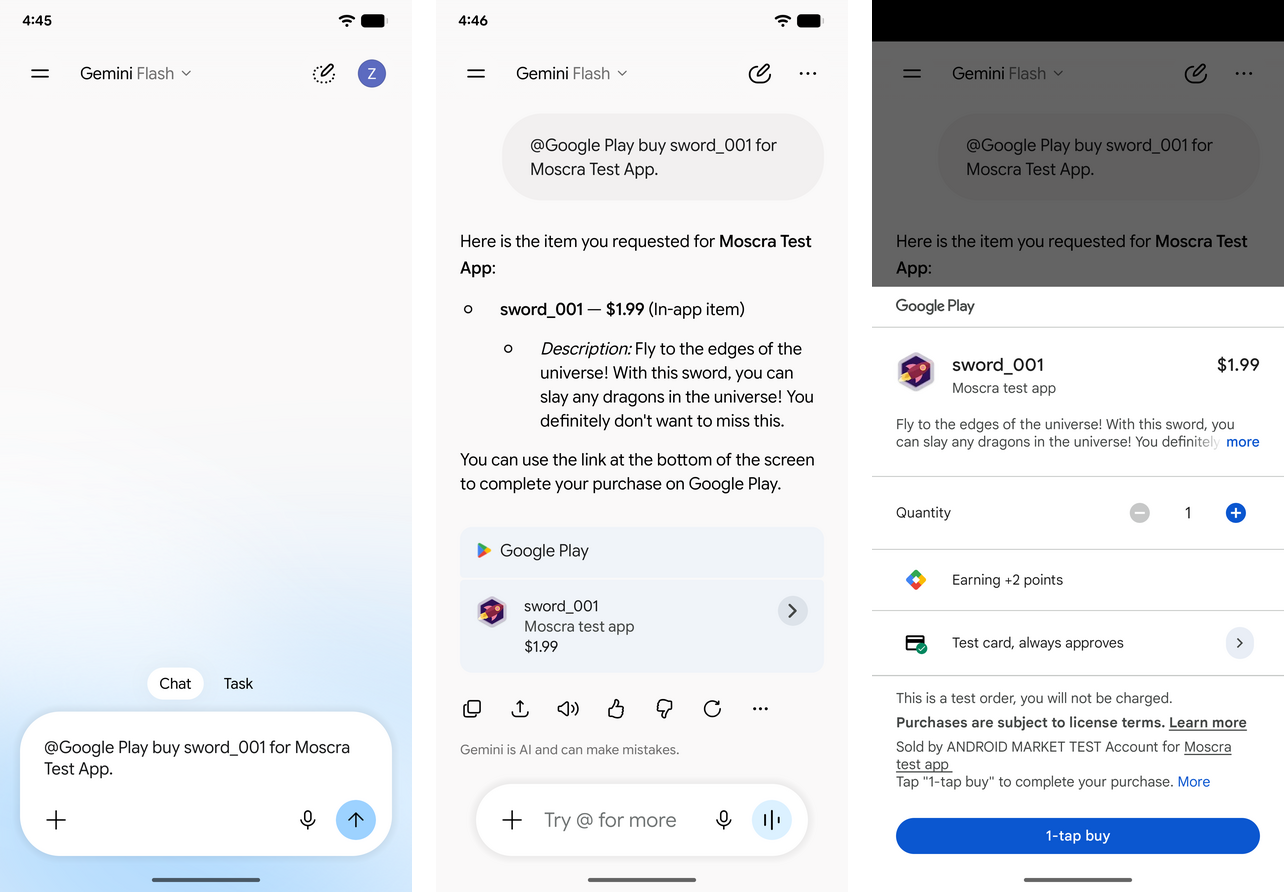
Users can discover and purchase in-app products directly from Gemini responses. While an out-of-app purchase test is active, Gemini surfaces the product and offer that you configured in Play Billing Lab at the highest priority for your licensed tester account.
- Open the Gemini app and sign in with the same licensed tester account that you used to configure the test in Play Billing Lab and to sign in to the Play Store.
- Enter a prompt that includes
@Google Playand shows a clear intent to purchase an in-app item, such as@Google Play buy <product name> for <app name>.- While the test is active, the product name and app name in the prompt don't affect which product Gemini shows. However, we recommend using valid product and app names.
- Verify that Gemini shows a card with the product and offer that you configured in Play Billing Lab.
- Tap the card to open the Google Play purchase bottom sheet in Gemini.
- Review the price, payment method, and offer details, and then complete the purchase.
If Gemini doesn't show the product that you configured, check the following:
- Your prompt includes
@Google Play. Without it, Gemini might not use Google Play to answer your prompt. - Your prompt includes a purchase keyword, such as buy, purchase, get,
or order. Informational prompts, such as
what is <app name>, don't surface products. - You're signed in to Gemini, the Play Store, and Play Billing Lab with the exact same licensed tester account.
- Your test hasn't expired. In Play Billing Lab, check whether the test status has changed from Active. If the test has expired, start a new test.
Change or stop an active test
While an out-of-app purchase test is active, you can't change the package name, product ID, offer, or test country. To change any of these settings, you must first stop the active test:
- In Play Billing Lab, tap View on the active Out-of-app purchases card.
- Tap Edit next to the setting that you want to change.
- When prompted, tap Stop test. Play Billing Lab stops the test and clears the related test inputs.
- Enter your new settings, and then tap Start test.
If you try to edit the test country from the Configuration settings card while an out-of-app purchase test is active, Play Billing Lab also prompts you to stop the test first.
To stop the test without changing any settings, tap Clear test on the Out-of-app purchase page. Play Billing Lab removes the test configuration, and Google Play returns to its original behavior.