
Guides young learners with a brand-new immersive classroom and interactive digital teacher
The ABCmouse team redesigned its classroom to help even the youngest players choose age-appropriate learning experiences that match their level and their interests. Their interactive teacher, Ms. Douglas, replaces the traditional activity menu with a guided, character-led experience that empowers young learners to make good learning choices.
Designing for kids ages 2-8 means designing around constraints adults rarely think about. Pre-readers can't navigate text-based menus or discrete touch targets. And young learners often don't know what to pick next, or get overwhelmed by too many choices at once. The team approached this not as a navigation problem but as a teaching problem — replacing a static grid of options with a character who guides, prompts, and responds. Ms. Douglas points kids toward subjects that match their level and interests, turning a potential moment of decision fatigue into a moment of connection. The immersive classroom environment reinforces it: every detail, from the alphabet border to the dinosaurs on the floor, signals that this is a place built for them.
The redesign doubled average time in the ABCmouse Classroom and added 12% to overall daily learning time.
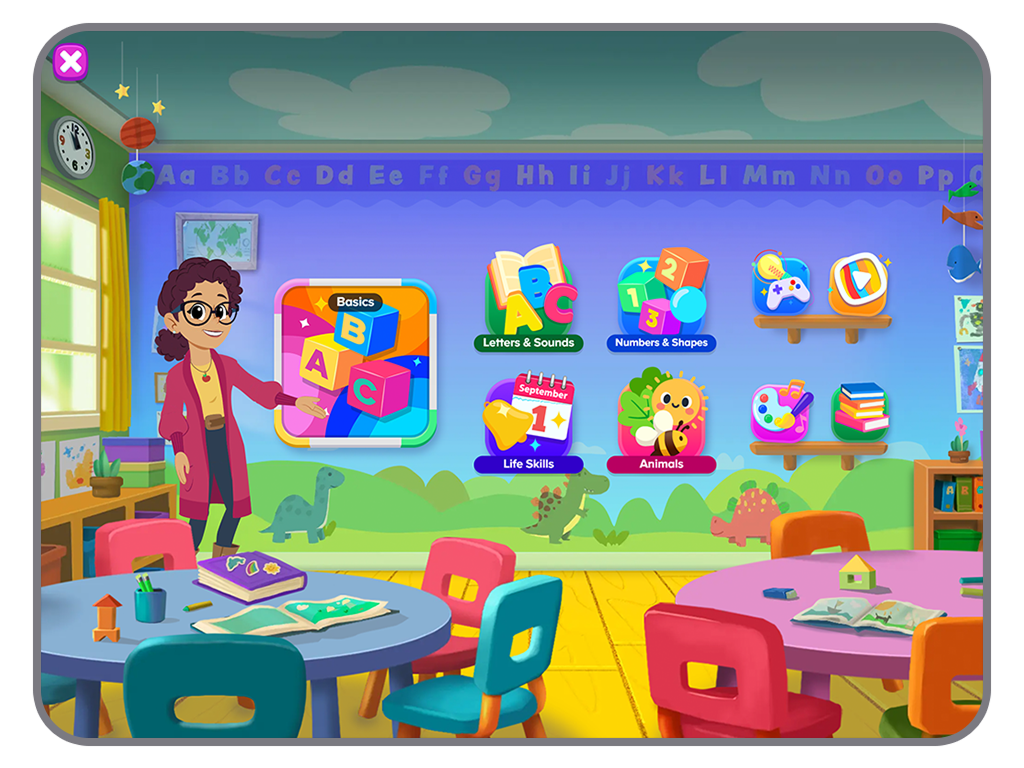
Increased learning time and engagement with a gamified, kid-first design.
As families look for screen time that translates into real learning, the ABCmouse team rebuilt its core curriculum experience around what works for young learners. This includes gamified instruction and practice, new vibrant art in lush environments, and interactive avatars. The team also focused on learner confidence with "I can!" statements that describe what they learned in each new biome.
Small hands need bigger touch targets and forgiving gestures. Pre-readers need visual and audio cues over text. Short attention spans need momentum and clear progress markers built into the flow. The team approached gamification not as a layer of rewards bolted onto lessons, but as the structure of the experience itself — biomes that signal a fresh chapter, avatars that build a sense of ownership, and pacing that mirrors how kids actually play. Every interaction is designed to keep the learning visible while making the journey feel like an adventure worth coming back to.
Designed for small hands and built to work across phones, tablets, and larger screens, the new ABCmouse Learning Path doubled the average time spent learning, with +129% on math and +80% on reading.