Applicable XR devices This guidance helps you build experiences for these types of XR devices. [Learn about XR device types →](https://developer.android.com/develop/xr/devices)  XR Headsets [](https://developer.android.com/develop/xr/devices#xr-headsets)  Wired XR Glasses [](https://developer.android.com/develop/xr/devices#xr-glasses) [Learn about XR device types →](https://developer.android.com/develop/xr/devices)
[Spatial Containers](https://developer.android.com/develop/xr/openxr/spatial-containers) let your app render 3D OpenXR content inside a
system-managed 3D volumetric bounding box in Full Space Mode, or transition at
runtime into a full-screen unbounded experience.
Follow this guide to configure and use Spatial Containers in your project.
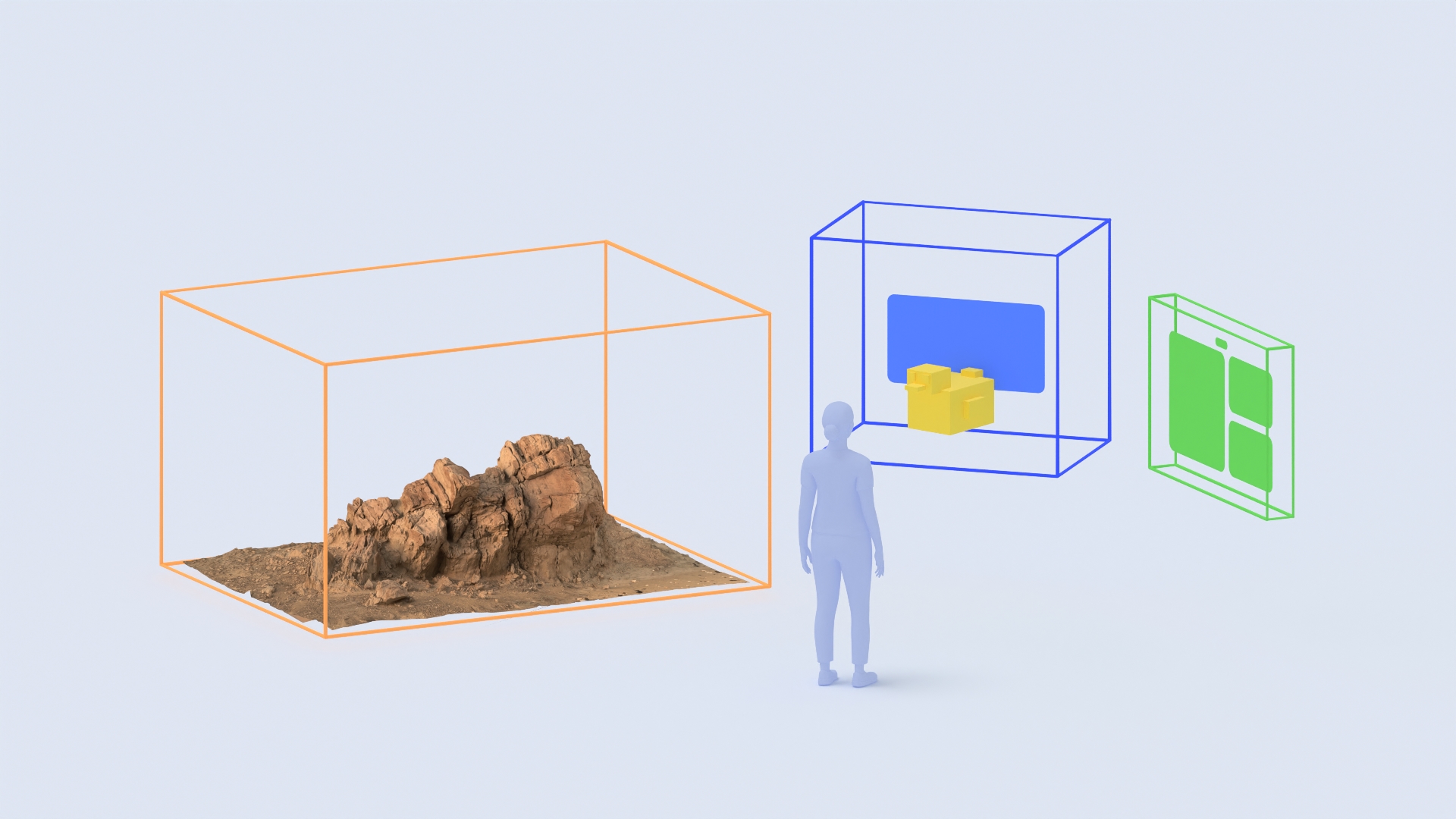 **Figure 1.** Spatial containers in Full Space Mode, including a floor-locked 3D terrain container and a 3D model paired with 2D UI.
## How Spatial Containers work
When you enable the **Spatial Container** OpenXR feature:
- Your entire active 3D scene is placed inside a single primary spatial container centered at the scene origin `(0, 0, 0)`. You don't need to tag or assign individual GameObjects to place them inside the container.
- Your app launches into managed Full Space Mode inside a bounded 3D box using the **Suggested Bounds** configured in your project settings (`2.0m × 2.0m ×
2.0m` by default). In bounded mode, the system automatically clips any 3D geometry in your scene that extends outside the bounding box's dimensions.
- By default, the Android XR system provides window controls so the user can grab, move, and reposition the bounded container in 3D space, or minimize and close it. At runtime, your app can resize the container (`TrySuggestBounds`), switch between bounded mode and full-screen immersive mode (`TryRequestBoundsMode`), and react to bounds and state changes using [`XRSpatialContainerFeature`](https://developer.android.com/develop/xr/unity/reference/class/Google/XR/Extensions/XRSpatialContainerFeature).
## Prerequisites
Before beginning, ensure your development environment and target device meet
the following requirements:
- **Unity version** : Unity 6 [version 6000.0.58f2](https://unity.com/releases/editor/whats-new/6000.0.58f2) or higher.
- **Project setup** : Complete all steps in the [Unity project setup](https://developer.android.com/develop/xr/unity/setup) guide.
- **Unity packages** : Complete all steps in the [Android XR Extensions for
Unity quickstart](https://developer.android.com/develop/xr/unity/xr-extensions-quickstart) guide. When importing packages, use version 1.5.0 or higher of the Android XR Extensions for Unity. This is provided as a tar file in [each release](https://github.com/android/android-xr-unity-package/releases).
- **Target device** : An Android XR device supporting [Spatial API Level 4](https://developer.android.com/reference/kotlin/androidx/xr/runtime/SpatialApiVersions#SPATIAL_API_V4()) or higher. At runtime, check `XRSpatialContainerFeature.IsExtensionEnabled` to verify whether the extension is available on the device.
## Enable Full Space Mode and Spatial Containers
By default, full-screen OpenXR apps launch in unmanaged Full Space Mode
(`XR_ACTIVITY_START_MODE_FULL_SPACE_UNMANAGED`). Because Spatial Containers only
support managed Full Space Mode (`XR_ACTIVITY_START_MODE_FULL_SPACE_MANAGED`),
clear **Immersive XR** in the Session Management feature settings and configure
your activity to start in `XR_ACTIVITY_START_MODE_FULL_SPACE_MANAGED`.
### Enable the OpenXR and Spatial Container features
1. Navigate to **Edit \> Project Settings \> XR Plug-in Management**.
2. Select the **Android** tab, select **OpenXR** , and select **Android XR
(Extensions) feature group**.
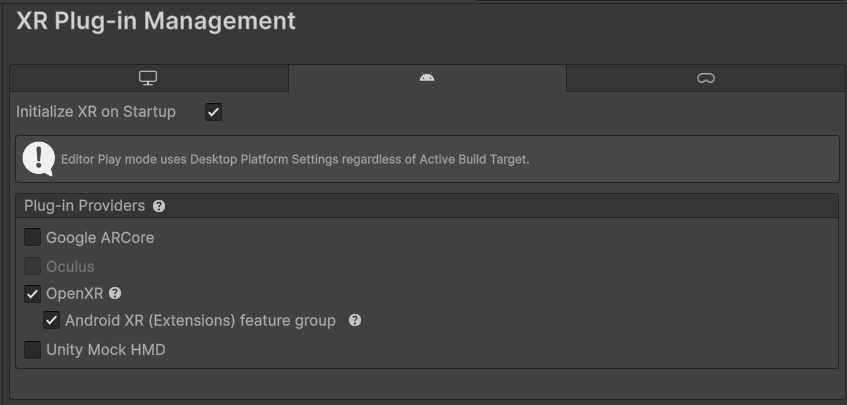 **Figure 2.** Enable OpenXR and the Android XR (Extensions) feature group.
3. Under **XR Plug-in Management** , select **OpenXR** to view the **OpenXR
Feature Groups**.
4. Click **Settings** next to
**Android XR (Extensions): Session Management** and configure the following
settings:
- Clear **Immersive XR** . Clearing **Immersive XR** prevents the build from injecting `XR_ACTIVITY_START_MODE_FULL_SPACE_UNMANAGED`.
- Select **Use XR Spatial API** , set **Requirement** to **Required** , and set **Target API Level** to **Automatic (highest supported)**.
- Clear **Subsampling (Vulkan)**. Vulkan subsampling is not compatible with Spatial Containers.
5. In the **OpenXR Feature Groups** list, enable **Spatial Container**
(`Google.XR.Extensions.XRSpatialContainerFeature`).
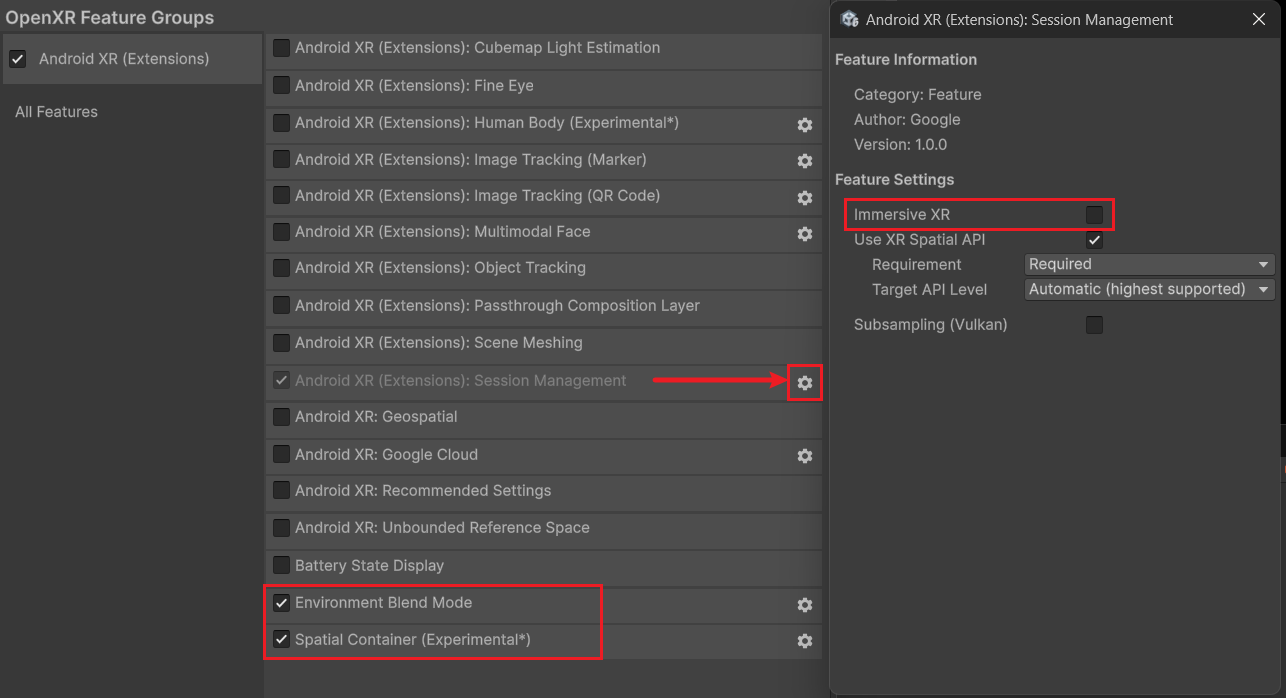 **Figure 3.** Clear **Immersive XR** in **Android XR (Extensions): Session Management** and enable **Spatial Container**.
6. Click **Settings** next to
**Spatial Container** and set [**Suggested Bounds**](https://developer.android.com/develop/xr/unity/reference/class/Google/XR/Extensions/XRSpatialContainerFeature#suggestedbounds) to the initial
width (`X`), height (`Y`), and depth (`Z`) of the spatial container in
meters when in bounded mode. The default value is `(2.0, 2.0, 2.0)`, and
all three values must be greater than `0`.
### Configure Full Space Mode in AndroidManifest.xml
When you clear **Immersive XR** and enable **Spatial Container** , the Android XR
Extensions for Unity build hook automatically sets
`android.window.PROPERTY_XR_ACTIVITY_START_MODE` to
`XR_ACTIVITY_START_MODE_FULL_SPACE_MANAGED` in your app's `AndroidManifest.xml`
during the build.
If your project uses a **Custom Main Manifest** in **Edit \> Project Settings \>
Player \> Android \> Publishing Settings**
(`Assets/Plugins/Android/AndroidManifest.xml`), or if another package overrides
the start mode property, ensure that
`android.window.PROPERTY_XR_ACTIVITY_START_MODE` is set to
`XR_ACTIVITY_START_MODE_FULL_SPACE_MANAGED`:
...
### Configure transparent camera background for bounded mode
Configure your camera so that the surrounding environment remains visible
outside your 3D models in bounded mode:
1. Select your scene's **Main Camera** inside the **XR Origin**.
2. Set **Background Type** to **Solid Color** and set the background color's alpha channel (`A`) to `0` (`RGBA(0, 0, 0, 0)`).
## Add and request feature-specific permissions
Creating and rendering a basic spatial container does not require dangerous
runtime permissions. However, if your app uses scene understanding features
such as locking and anchoring a spatial container to the physical floor, your
app must request the [`android.permission.SCENE_UNDERSTANDING_COARSE`](https://developer.android.com/develop/xr/permissions#scene_understanding_coarse)
permission at runtime (and `android.permission.HEAD_TRACKING` if your app tracks
the user's head pose).
> [!NOTE]
> **Note:** When you enable the **Spatial Container** feature in Project Settings, the Android XR Extensions for Unity build hook automatically adds the `android.permission.SCENE_UNDERSTANDING_COARSE` `` element to your `AndroidManifest.xml`.
See [Understand permissions for XR](https://developer.android.com/develop/xr/permissions#scene_understanding_coarse) for a full overview of Android XR
permissions. If your app uses floor locking or scene understanding, request
`SCENE_UNDERSTANDING_COARSE` at runtime:
string permission =
XRSpatialContainerFeature.RequiredPermission.ToPermissionString();
if (!Permission.HasUserAuthorizedPermission(permission))
{
Permission.RequestUserPermission(permission);
}
## Work with Spatial Containers at runtime
The [`XRSpatialContainerFeature`](https://developer.android.com/develop/xr/unity/reference/class/Google/XR/Extensions/XRSpatialContainerFeature) OpenXR feature manages the spatial
container lifecycle and provides static methods and events to inspect the
container's current state and bounds, respond to bounds and state changes, and
request transitions between bounded mode and immersive mode. To verify at
runtime that the Spatial Container extension is supported and active on the
current device, check `XRSpatialContainerFeature.IsExtensionEnabled`.
### Listen for bounds and state changes
Subscribe to `XRSpatialContainerFeature` events in `OnEnable` and unsubscribe in
`OnDisable` to respond when the container is resized or its state flags
([`XRSpatialContainerStateFlags`](https://developer.android.com/develop/xr/unity/reference/namespace/Google/XR/Extensions#xrspatialcontainerstateflags)) change.
`OnSpatialContainerStateChanged` fires whenever any of the following
[`XRSpatialContainerStateFlags`](https://developer.android.com/develop/xr/unity/reference/namespace/Google/XR/Extensions#xrspatialcontainerstateflags) values change:
- `XRSpatialContainerStateFlags.Visible`: Indicates whether the container is currently visible (`true`) or hidden (`false`). Pause animations, audio, or simulation updates when `state` is `false`.
- `XRSpatialContainerStateFlags.Interactive`: Indicates whether the container is focused and receiving user input (`true`) or unfocused (`false`). Enable or disable interactive highlights and input handling when focus changes.
- `XRSpatialContainerStateFlags.Immersive`: Indicates whether the container is in immersive mode (`true`) or bounded mode (`false`). Toggle environment visuals (such as skyboxes or passthrough) and mode-specific UI controls.
void OnEnable()
{
XRSpatialContainerFeature.OnSpatialContainerBoundsChanged += OnBoundsChanged;
XRSpatialContainerFeature.OnSpatialContainerStateChanged += OnStateChanged;
}
void OnDisable()
{
XRSpatialContainerFeature.OnSpatialContainerBoundsChanged -= OnBoundsChanged;
XRSpatialContainerFeature.OnSpatialContainerStateChanged -= OnStateChanged;
}
private void OnStateChanged(XRSpatialContainerStateFlags flag, bool state)
{
switch (flag)
{
case XRSpatialContainerStateFlags.Visible:
// Pause or resume simulation and audio based on visibility
break;
case XRSpatialContainerStateFlags.Interactive:
// Enable or disable input handling and focus highlights
break;
case XRSpatialContainerStateFlags.Immersive:
// Update environment visuals for immersive (true) or bounded (false) mode
break;
}
}
### Scale content to container bounds
When in bounded mode, scale your 3D content uniformly by the smallest dimension
of `bounds` so that it preserves its aspect ratio and always fits inside the
smallest side of the container. When `infiniteBounds` is `true` (immersive
mode), restore your content to its full 1:1 world scale:
private void OnBoundsChanged(Vector3 bounds, bool infiniteBounds)
{
if (infiniteBounds)
{
contentRoot.localScale = Vector3.one;
return;
}
float minScale = Mathf.Min(bounds.x, bounds.y, bounds.z);
contentRoot.localScale = Vector3.one * minScale;
}
### Switch between bounded and immersive modes
Call `TryRequestBoundsMode` to transition the spatial container between bounded
mode (`false`) and immersive mode (`true`):
// Request transitioning to immersive mode (pass false for bounded mode)
XRSpatialContainerFeature.TryRequestBoundsMode(immersive: true);
See the [`XRSpatialContainerFeature` reference documentation](https://developer.android.com/develop/xr/unity/reference/class/Google/XR/Extensions/XRSpatialContainerFeature) for full
details on all methods, properties, and events.
## See also
- [Build with Spatial Containers](https://developer.android.com/develop/xr/openxr/spatial-containers)
- [`XRSpatialContainerFeature` API reference](https://developer.android.com/develop/xr/unity/reference/class/Google/XR/Extensions/XRSpatialContainerFeature)
- [Understand permissions for XR](https://developer.android.com/develop/xr/permissions#scene_understanding_coarse)
*** ** * ** ***
OpenXR™ and the OpenXR logo are trademarks owned
by The Khronos Group Inc. and are registered as a trademark in China,
the European Union, Japan and the United Kingdom.