Applicable XR devices This guidance helps you build experiences for these types of XR devices. [Learn about XR device types →](https://developer.android.com/develop/xr/devices)  XR Headsets [](https://developer.android.com/develop/xr/devices#xr-headsets)  Wired XR Glasses [](https://developer.android.com/develop/xr/devices#xr-glasses) [Learn about XR device types →](https://developer.android.com/develop/xr/devices)
Spatial Containers bring volumetric windowing to OpenXR. Defined by the
[`XR_EXT_spatial_container`](https://registry.khronos.org/OpenXR/specs/1.1/html/xrspec.html#XR_EXT_spatial_container) and
[`XR_EXT_spatial_container_self_rendering`](https://registry.khronos.org/OpenXR/specs/1.1/html/xrspec.html#XR_EXT_spatial_container_self_rendering) extensions in OpenXR
1.1, a spatial container is a system-managed 3D volumetric region in the user's
space where your app renders 3D content using standard OpenXR composition
layers.
Traditionally, an OpenXR session claims exclusive access to the user's entire
field of view. Spatial Containers let your app render 3D OpenXR content inside a
bounded 3D box in the user's environment, or transition into an unbounded,
full-screen immersive experience at any time.
Alas, your browser doesn't support HTML5 video. That's OK! You can still [download the
video](https://developer.android.com/static/images/develop/xr/openxr/spatial-containers/fsm-small.mp4) and watch it with a video player.
## About Spatial Containers
A spatial container is a bounded or unbounded 3D region that is managed by the
Android XR system and rendered by your OpenXR app:
- **Bounded mode**: Your app suggests 3D dimensions (width, height, and depth in meters), and the system allocates a 3D bounding box in the user's environment. Your app renders stereo 3D content inside the volume, and the system clips rendered content to the boundaries of the 3D box.
- **Immersive mode**: The spatial container expands to infinite bounds, giving your app the user's entire field of view like a traditional full-screen OpenXR session.
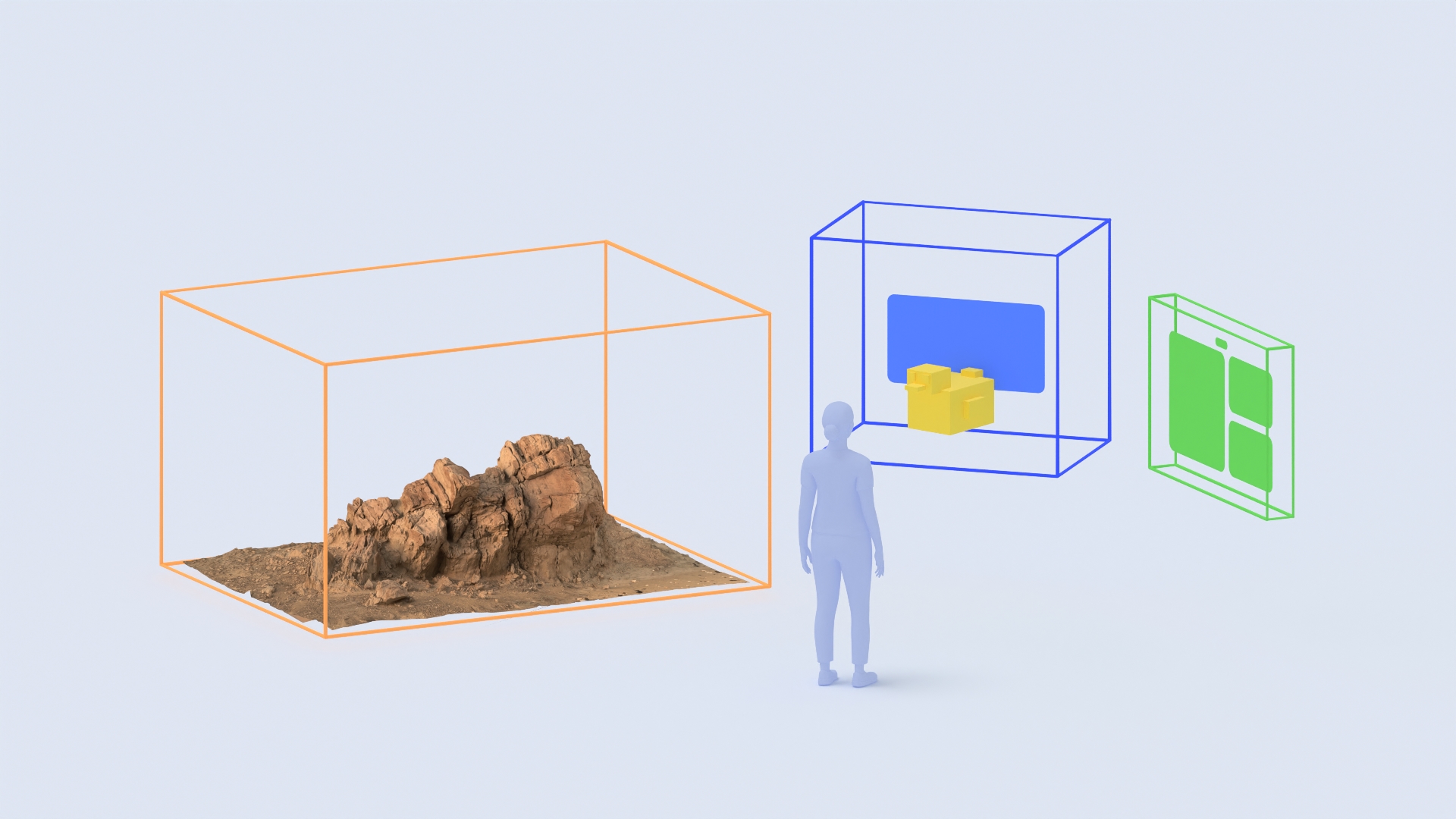 **Figure 1.** Multiple spatial containers in Full Space Mode: a floor-locked 3D terrain volume (left), a 3D duck volume paired with 2D UI (center), and a 2D UI container (right).
## How users interact with Spatial Containers
The Android XR system manages the spatial container's window controls and
placement in physical space, providing a consistent interaction model across
apps:
- **Moving and repositioning**: Users can grab a spatial container's system handle using hand gestures (such as pinching) or motion controllers to reposition it in 3D space.
- **Minimizing and closing**: System window controls let users minimize or close individual spatial containers. When a user closes a container, the system notifies your app so it can clean up resources.
- **Locking to the floor with scene understanding** : When your app declares and requests the [`android.permission.SCENE_UNDERSTANDING_COARSE`](https://developer.android.com/develop/xr/permissions#scene_understanding_coarse) permission, the system automatically enables surface snapping so users can place and lock a spatial container to the physical floor without additional app configuration, as shown by the orange terrain container in Figure 1.
- **Direct 3D interaction**: When a container is focused and interactive, users can interact directly with the 3D content inside the volume using hand tracking, eye gaze, or 6DoF controllers.
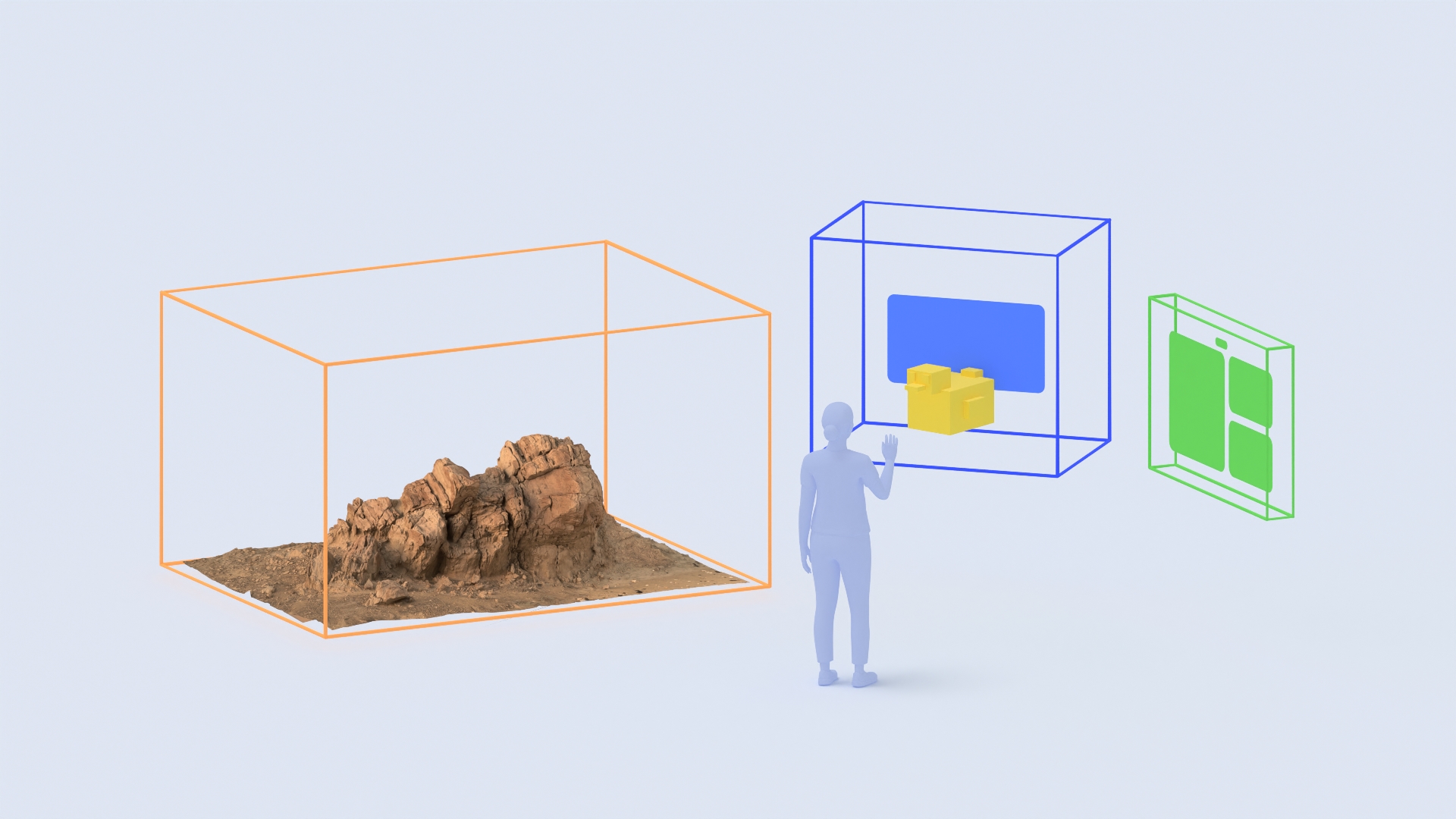 **Figure 2.** A user interacting with 3D content inside a bounded spatial container using hand tracking.
- **Transitioning between bounded and immersive modes**: Either the user or your app can switch a container between a bounded 3D box and an unbounded full-screen immersive view without restarting the OpenXR session.
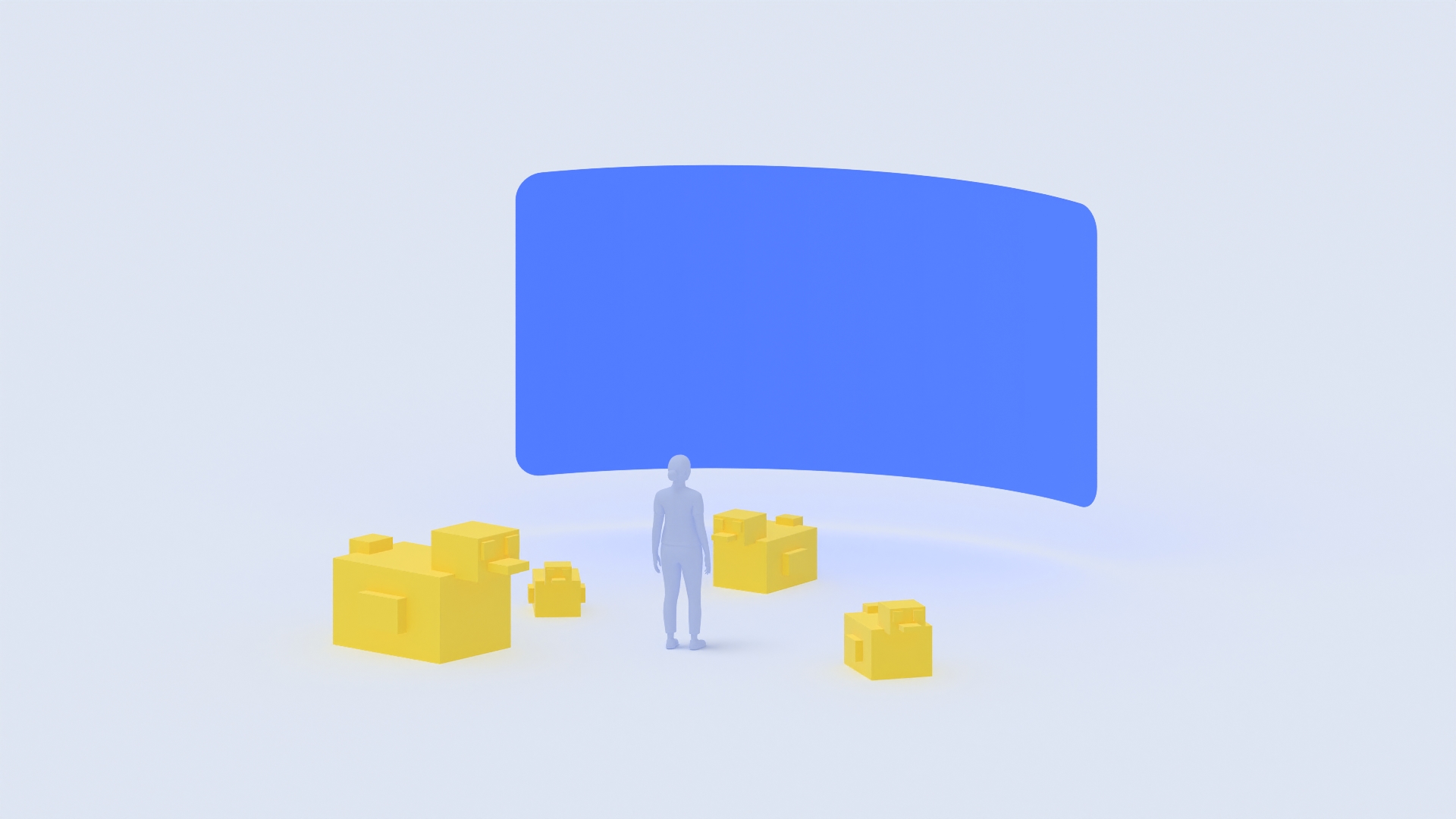 **Figure 3.** The spatial container after transitioning from bounded mode to immersive mode, filling the user's field of view.
- **Follow mode on the go** : Because the system controls the pose of each spatial container's coordinate space (`xrCreateSpatialContainerSpaceEXT`), users can enable follow mode from the system window controls so a bounded 3D container automatically follows them and stays in their field of view while they walk around---without requiring any additional configuration in your app.
Alas, your browser doesn't support HTML5 video. That's OK! You can still [download the
video](https://developer.android.com/static/images/develop/xr/openxr/spatial-containers/follow-loop-small.mp4) and watch it with a video player.
## How to use Spatial Containers on Android XR
When building an app with Spatial Containers, design your scene around the
container's bounds, state changes, and background blend mode.
### Adapt your 3D content to container bounds
In bounded mode, the origin `(0, 0, 0)` of the spatial container space
(`xrCreateSpatialContainerSpaceEXT`) is at the center of the 3D bounding box.
Because the system manages the container space's pose in the user's
environment, your app renders its 3D content relative to `(0, 0, 0)` while the
system handles user repositioning and follow mode. The system clips any geometry
rendered outside the box's width, height, or depth so that content stays within
its assigned volume.
Your app should listen for bounds change events from the runtime and scale or
reposition your 3D scene so that key content fits within the container's
current dimensions. When the container transitions to immersive mode, the
bounds become infinite and you can restore your scene to its full 1:1 world
scale.
### Respond to container state changes
Instead of managing visibility and focus only at the application level, each
spatial container reports its own state so your app can react accordingly:
- **Visibility**: Indicates whether the container is currently shown or hidden. Pause animations, audio, or simulation updates while the container is hidden. Your app can also request to show or hide a container.
- **Interactability**: Indicates whether the container is focused and receiving user input from hand tracking, controllers, or eye gaze. Enable or disable interactive highlights and input handling when focus changes.
- **Bounds mode** : Indicates whether the container is currently in `XR_SPATIAL_CONTAINER_BOUNDS_MODE_BOUNDED_EXT` (clipped to a 3D box) or `XR_SPATIAL_CONTAINER_BOUNDS_MODE_IMMERSIVE_EXT` (unbounded full-screen). Update your scene scale and toggle environment visuals (such as skyboxes or passthrough) when the mode changes. Your app can also request transitions between bounded and immersive modes at any time.
### Use alpha-blended transparency in bounded mode
In bounded mode, a transparent background lets the user's physical surroundings
and other windows remain visible around your 3D models. Configure your camera
or viewport with a transparent background and use the alpha-blend environment
blend mode. When switching to immersive mode, you can either keep passthrough
enabled or switch to an opaque skybox environment.
## Check feature availability and configure your manifest
Spatial Containers require an Android XR device supporting [Spatial API Level
4](https://developer.android.com/reference/kotlin/androidx/xr/runtime/SpatialApiVersions#SPATIAL_API_V4()) or higher. Rather than checking the Android API level directly, query the
OpenXR runtime to determine whether Spatial Containers are supported by calling
`xrEnumerateInstanceExtensionProperties` to verify that
`XR_EXT_spatial_container` and `XR_EXT_spatial_container_self_rendering` are
available, and calling `xrGetSystemProperties` with
`XrSystemSpatialContainerPropertiesEXT` to inspect `supportsBounded` and
`supportsImmersive`.
Before building an app that uses Spatial Containers, configure your activity
start mode and any feature-specific permissions in `AndroidManifest.xml`.
### Enable Full Space Mode in AndroidManifest.xml
Spatial Containers require Full Space Managed mode, even for standalone OpenXR
apps. Traditional full-screen OpenXR apps declare
`XR_ACTIVITY_START_MODE_FULL_SPACE_UNMANAGED` to take exclusive control of the
display without system window management. By contrast, an app using Spatial
Containers relies on the Android XR system compositor to manage 3D bounded
volumes, window controls, and spatial placement in Full Space Mode, and must set
`android.window.PROPERTY_XR_ACTIVITY_START_MODE` to
`XR_ACTIVITY_START_MODE_FULL_SPACE_MANAGED`:
### Declare and request feature-specific permissions
Creating and rendering a basic spatial container does not require dangerous
runtime permissions. However, specific features require declaring and requesting
the corresponding Android XR permissions:
- To lock and anchor a spatial container to the physical floor using scene understanding, declare and request the dangerous [`android.permission.SCENE_UNDERSTANDING_COARSE`](https://developer.android.com/develop/xr/permissions#scene_understanding_coarse) permission at runtime.
- To track the user's head pose in OpenXR, declare and request `android.permission.HEAD_TRACKING`.
See [Understand permissions for XR](https://developer.android.com/develop/xr/permissions#scene_understanding_coarse) for details on declaring and requesting
dangerous XR permissions at runtime.
## Enable Spatial Containers in your project
You can build with Spatial Containers using Unity, Godot, or directly with
OpenXR in C++. Select a tab to see the prerequisites, editor setup, and code
example for your preferred environment:
### Unity
**Prerequisites**
- **Unity version** : Unity 6 [version 6000.0.58f2](https://unity.com/releases/editor/whats-new/6000.0.58f2) or higher.
- **Project setup** : Complete all steps in the [Unity project setup](https://developer.android.com/develop/xr/unity/setup) guide.
- **Unity packages** : Install version 1.5.0 or higher of the [Android XR
Extensions for Unity](https://github.com/android/android-xr-unity-package/releases) package.
**Configure your project**
1. Navigate to **Edit \> Project Settings \> XR Plug-in Management \>
OpenXR**.
2. Click **Settings** next to **Android XR (Extensions): Session Management** and clear **Immersive
XR**.
3. In the **OpenXR Feature Groups** list, enable **Spatial Container**.
Use [`XRSpatialContainerFeature`](https://developer.android.com/develop/xr/unity/reference/class/Google/XR/Extensions/XRSpatialContainerFeature) in C# to query bounds, respond to
container events, and switch between bounded and immersive modes:
void OnEnable()
{
XRSpatialContainerFeature.OnSpatialContainerBoundsChanged += OnBoundsChanged;
}
private void OnBoundsChanged(Vector3 bounds, bool infiniteBounds)
{
float minScale = Mathf.Min(bounds.x, bounds.y, bounds.z);
transform.localScale = infiniteBounds ? Vector3.one : Vector3.one * minScale;
}
public void SetImmersiveMode(bool immersive)
{
XRSpatialContainerFeature.TryRequestBoundsMode(immersive);
}
For complete project setup steps, manifest configuration, and permission
handling, see [Use Spatial Containers in Unity](https://developer.android.com/develop/xr/unity/spatial-containers).
### Godot
**Prerequisites**
- **Godot version** : [Godot 4.8-dev](https://godotengine.org/download/) or higher.
- **Project setup** : Complete all steps in the [Godot Engine project
setup](https://developer.android.com/develop/xr/godot/setup) guide.
- **Godot OpenXR Vendors Plugin** : Install version 5.2 or higher of the [Godot OpenXR Vendors Plugin](https://github.com/GodotVR/godot_openxr_vendors).
**Configure your project**
1. Navigate to **Project \> Project Settings** , enable **Advanced
Settings** , and go to **General \> XR \> OpenXR \> Extensions**.
2. Under the **Spatial Container** subsection, select **Enabled** and configure **Bounds Mode** and **Bounds**.
3. Navigate to **Project \> Export... \> Android** and select **Use
Experimental Features** under **Android XR Features**.
Use the `OpenXRSpatialContainerExtension` singleton in GDScript to respond
to container bounds and mode changes:
func _ready() -> void:
if OpenXRSpatialContainerExtension.is_enabled():
OpenXRSpatialContainerExtension.spatial_container_bounds_changed.connect(
_on_bounds_changed
)
func _on_bounds_changed(_rid: RID, bounds: Vector3) -> void:
scale = Vector3.ONE * min(bounds.x, bounds.y, bounds.z)
func set_immersive_mode() -> void:
OpenXRSpatialContainerExtension.request_main_spatial_container_bounds_mode(
OpenXRSpatialContainerState.IMMERSIVE
)
For complete project settings, export permissions, and GDScript examples,
see [Use Spatial Containers in Godot](https://developer.android.com/develop/xr/godot/spatial-containers).
### OpenXR
**Prerequisites**
- **OpenXR version** : OpenXR 1.1 headers with [`XR_EXT_spatial_container`](https://registry.khronos.org/OpenXR/specs/1.1/html/xrspec.html#XR_EXT_spatial_container) and [`XR_EXT_spatial_container_self_rendering`](https://registry.khronos.org/OpenXR/specs/1.1/html/xrspec.html#XR_EXT_spatial_container_self_rendering).
- **Manifest setup** : Configure your app manifest as described in [Get started with OpenXR for Android XR](https://developer.android.com/develop/xr/openxr/get-started), using `XR_ACTIVITY_START_MODE_FULL_SPACE_MANAGED`.
Enable `XR_EXT_spatial_container` and
`XR_EXT_spatial_container_self_rendering` when creating your `XrInstance`,
then create and render your spatial container:
// 1. Enable the Spatial Container extensions during xrCreateInstance
const char* enabledExtensions[] = {
XR_EXT_SPATIAL_CONTAINER_EXTENSION_NAME,
XR_EXT_SPATIAL_CONTAINER_SELF_RENDERING_EXTENSION_NAME,
};
// 2. Configure and create a self-rendering spatial container
XrSpatialContainerConfigurationSelfRenderingEXT selfRenderingConfig{
.type = XR_TYPE_SPATIAL_CONTAINER_CONFIGURATION_SELF_RENDERING_EXT,
.next = nullptr,
.viewConfigurationType = XR_VIEW_CONFIGURATION_TYPE_PRIMARY_STEREO,
.suggestedBounds = {1.5f, 1.5f, 1.5f}, // Width, height, depth in meters
};
XrSpatialContainerCreateInfoEXT createInfo{
.type = XR_TYPE_SPATIAL_CONTAINER_CREATE_INFO_EXT,
.next = &selfRenderingConfig,
.spatialContainerConfig =
reinterpret_cast(
&selfRenderingConfig),
};
XrSpatialContainerEXT spatialContainer = XR_NULL_HANDLE;
xrCreateSpatialContainerEXT(session, &createInfo, &spatialContainer);
// 3. Request bounded mode and make the container visible
xrRequestSpatialContainerBoundsModeEXT(
spatialContainer, XR_SPATIAL_CONTAINER_BOUNDS_MODE_BOUNDED_EXT);
xrRequestSpatialContainerVisibilityEXT(spatialContainer, XR_TRUE);
## See also
- [Use Spatial Containers in Unity](https://developer.android.com/develop/xr/unity/spatial-containers)
- [Use Spatial Containers in Godot](https://developer.android.com/develop/xr/godot/spatial-containers)
- [Understand permissions for XR](https://developer.android.com/develop/xr/permissions#scene_understanding_coarse)
*** ** * ** ***
OpenXR™ and the OpenXR logo are trademarks owned
by The Khronos Group Inc. and are registered as a trademark in China,
the European Union, Japan and the United Kingdom.