Applicable XR devices This guidance helps you build experiences for these types of XR devices. [Learn about XR device types →](https://developer.android.com/develop/xr/devices)  XR Headsets [](https://developer.android.com/develop/xr/devices#xr-headsets)  Wired XR Glasses [](https://developer.android.com/develop/xr/devices#xr-glasses) [Learn about XR device types →](https://developer.android.com/develop/xr/devices)
[Spatial Containers](https://developer.android.com/develop/xr/openxr/spatial-containers) let your app render 3D OpenXR content inside a
system-managed 3D volumetric bounding box in Full Space Mode, or transition at
runtime into a full-screen unbounded experience.
Follow this guide to configure and use Spatial Containers in your project.
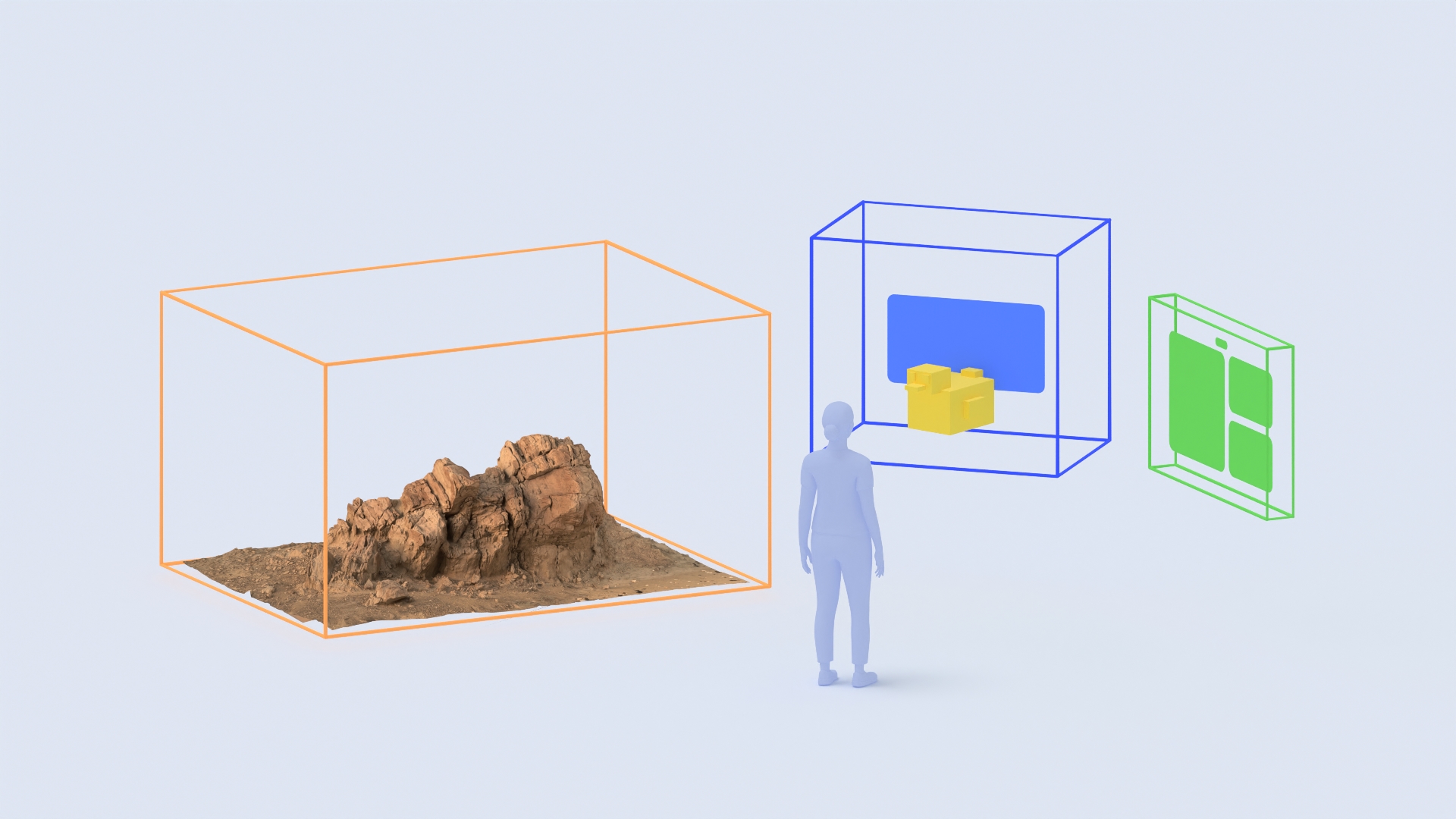 **Figure 1.** Spatial containers in Full Space Mode, including a floor-locked 3D terrain container and a 3D model paired with 2D UI.
## How Spatial Containers work
When you enable **Spatial Container** in your project settings:
- Your entire active 3D scene is placed inside a single primary spatial container centered at the scene origin `(0, 0, 0)`. You don't need to tag or assign individual `Node3D` nodes to place them inside the container.
- Your app launches into managed Full Space Mode using the **Bounds Mode** (`Bounded` or `Immersive`) and initial **Bounds** dimensions configured in your project settings. In bounded mode, the system automatically clips any 3D geometry in your scene that extends outside the bounding box's dimensions.
- By default, the Android XR system provides window controls so the user can grab, move, and reposition the bounded container in 3D space, or minimize and close it. At runtime, your app can resize the container, switch between bounded mode (`OpenXRSpatialContainerState.BOUNDED`) and full-screen immersive mode (`OpenXRSpatialContainerState.IMMERSIVE`), and react to bounds and state changes using the `OpenXRSpatialContainerExtension` singleton.
## Prerequisites
Before beginning, ensure your development environment and target device meet
the following requirements:
- **Godot version** : [Godot 4.8-dev](https://godotengine.org/download/) or higher.
- **Project setup** : Complete all steps in the [Godot Engine project setup](https://developer.android.com/develop/xr/godot/setup) guide.
- **Godot OpenXR Vendors Plugin** : Install version 5.2 or higher of the [Godot OpenXR Vendors Plugin](https://github.com/GodotVR/godot_openxr_vendors), which enables support for Android XR specific extensions.
- **Target device** : An Android XR device supporting [Spatial API Level 4](https://developer.android.com/reference/kotlin/androidx/xr/runtime/SpatialApiVersions#SPATIAL_API_V4()) or higher. At runtime, call `OpenXRSpatialContainerExtension.is_enabled()` to verify whether the extension is available on the device.
## Enable Spatial Containers in project settings
Configure your project settings to enable OpenXR, Spatial Containers, automatic
runtime permissions, and alpha-blended passthrough:
1. Open **Project \> Project Settings**.
2. Enable the **Advanced Settings** toggle in the top-right corner of the **Project Settings** window.
3. Navigate to **General \> XR \> Shaders** and select **Enabled**.
4. Navigate to **General \> XR \> OpenXR** and configure the following settings:
- Select **Enabled** to turn on OpenXR for the project.
- Set **Environment Blend Mode** to **Alpha Blend**.
5. Also under **OpenXR** , go to the **Extensions** section and configure the following settings:
- Select **Automatically Request Runtime Permissions** so your app automatically prompts the user at startup for any XR permissions declared in your Android manifest.
- Under the **Spatial Container** subsection, select **Enabled**.
- Set **Bounds Mode** to **Bounded** to launch in a 3D bounding box, or **Immersive** to launch in full-screen immersive mode.
- Set **Bounds** to the initial width, height, and depth dimensions in meters, such as `Vector3(1.0, 1.0, 1.0)`.
6. Navigate to **General \> Rendering \> Viewport** and select **Transparent
Background**.
## Configure Android export, permissions, and Full Space Mode
Next, configure your Android export preset, permissions, and activity start
mode so your app runs in Full Space Mode with Spatial Containers enabled.
### Configure the Android export preset
1. Go to **Project \> Export...** and select your **Android** export preset.
2. Under **Gradle Build** , select **Use Gradle Build** and set **Min SDK** to
`34` or higher.

3. Under **XR Features** , set **XR Mode** to **OpenXR** and select **Enable
AndroidXR Plugin**.

4. Under **Android XR Features** , select **Use Experimental Features**.
> [!NOTE]
> **Note:** The Godot OpenXR Vendors plugin checks that **Use Experimental
> Features** is enabled whenever **Spatial Container** is enabled, and injects ` android:name="com.android.extensions.xr.uses_experimental_openxr_feature"
> android:value="true" />` and ` android:name="android.permission.HEAD_TRACKING" />` into your app's `AndroidManifest.xml`.
### Add scene understanding permissions for floor locking
Creating and rendering a basic spatial container does not require dangerous
runtime permissions (and `android.permission.HEAD_TRACKING` is added to the
manifest automatically when **Use Experimental Features** is enabled). However,
if your app uses scene understanding features such as locking and anchoring a
spatial container to the physical floor, your app must declare and request the
[`android.permission.SCENE_UNDERSTANDING_COARSE`](https://developer.android.com/develop/xr/permissions#scene_understanding_coarse) permission at runtime.
See [Understand permissions for XR](https://developer.android.com/develop/xr/permissions#scene_understanding_coarse) for details on Android XR permissions.
If your app uses floor locking or scene understanding, declare and request
`android.permission.SCENE_UNDERSTANDING_COARSE`:
1. In **Project \> Export... \> Android** , go to **Permissions \> Custom
Permissions** and add `android.permission.SCENE_UNDERSTANDING_COARSE`.
> [!NOTE]
> **Note:** If your project already enables **Spatial Entities** or **Light
> Estimation** in **Project Settings \> General \> XR \> OpenXR \> Extensions** , the Godot OpenXR Vendors plugin injects `android.permission.SCENE_UNDERSTANDING_COARSE` into the manifest automatically.
2. When you select **Automatically Request Runtime Permissions** in **Project
Settings \> General \> XR \> OpenXR \> Extensions** , your app automatically
requests the permission when OpenXR starts. If you need to request the
permission manually in GDScript instead, call `OS.request_permission()`:
if not OS.get_granted_permissions().has("android.permission.SCENE_UNDERSTANDING_COARSE"):
OS.request_permission("android.permission.SCENE_UNDERSTANDING_COARSE")
### Configure Full Space Mode
Spatial Containers on Android XR only support Full Space Mode
(`XR_ACTIVITY_START_MODE_FULL_SPACE_MANAGED`). Make sure your Android activity
declares `XR_ACTIVITY_START_MODE_FULL_SPACE_MANAGED` in your custom build
template (`android/build/AndroidManifest.xml`, installed using **Project \>
Install Android Build Template...**):
...
## Work with Spatial Containers in GDScript
The `OpenXRSpatialContainerExtension` singleton and the
`OpenXRSpatialContainerState` class expose the
[`XR_EXT_spatial_container`](https://registry.khronos.org/OpenXR/specs/1.1/html/xrspec.html#XR_EXT_spatial_container) and
[`XR_EXT_spatial_container_self_rendering`](https://registry.khronos.org/OpenXR/specs/1.1/html/xrspec.html#XR_EXT_spatial_container_self_rendering) extensions to
GDScript. At runtime, use `OpenXRSpatialContainerExtension` to inspect the main
spatial container's state and bounds, listen for container signals, and request
transitions between `BOUNDED` mode (a 3D bounding box) and `IMMERSIVE` mode (a
full-screen unbounded view).
### Connect to Spatial Container signals
Check `OpenXRSpatialContainerExtension.is_enabled()` to verify that the Spatial
Container extension is supported and active on the current device, and connect
to container bounds and state signals in `_ready()`.
`OpenXRSpatialContainerExtension` emits the following state signals for the
spatial container:
- `spatial_container_visibility_changed`: Emitted with `(spatial_container,
is_visible)` when the container is shown (`true`) or hidden (`false`). Pause animations, audio, or simulation updates when `is_visible` is `false`.
- `spatial_container_interactability_changed`: Emitted with `(spatial_container, is_interactive)` when the container gains (`true`) or loses (`false`) user input focus. Enable or disable interactive highlights and input handling when focus changes.
- `spatial_container_bounds_mode_changed`: Emitted with `(spatial_container,
bounds_mode)` when the container switches between `OpenXRSpatialContainerState.BOUNDED` and `OpenXRSpatialContainerState.IMMERSIVE`. Toggle environment visuals (such as skyboxes or passthrough) and mode-specific UI controls.
func _ready() -> void:
if OpenXRSpatialContainerExtension.is_enabled():
OpenXRSpatialContainerExtension.spatial_container_bounds_changed.connect(
_on_bounds_changed
)
OpenXRSpatialContainerExtension.spatial_container_bounds_mode_changed.connect(
_on_bounds_mode_changed
)
OpenXRSpatialContainerExtension.spatial_container_visibility_changed.connect(
_on_visibility_changed
)
OpenXRSpatialContainerExtension.spatial_container_interactability_changed.connect(
_on_interactability_changed
)
func _on_visibility_changed(_rid: RID, is_visible: bool) -> void:
# Pause or resume simulation and audio based on visibility
pass
func _on_interactability_changed(_rid: RID, is_interactive: bool) -> void:
# Enable or disable input handling and focus highlights
pass
### Scale 3D content to container bounds
When in `BOUNDED` mode, scale your 3D content uniformly by the smallest
dimension of `bounds` so that it preserves its aspect ratio and always fits
inside the smallest side of the container. When transitioning to `IMMERSIVE`
mode, restore your scene to its 1:1 scale:
func _on_bounds_changed(_rid: RID, bounds: Vector3) -> void:
var uniform_scale: float = min(bounds.x, bounds.y, bounds.z)
content_root.scale = Vector3.ONE * uniform_scale
func _on_bounds_mode_changed(
_rid: RID, bounds_mode: OpenXRSpatialContainerState.BoundsMode
) -> void:
if bounds_mode == OpenXRSpatialContainerState.IMMERSIVE:
content_root.scale = Vector3.ONE
### Switch between bounded and immersive modes
Call `request_main_spatial_container_bounds_mode` with
`OpenXRSpatialContainerState.BOUNDED` or
`OpenXRSpatialContainerState.IMMERSIVE` to switch between a bounded 3D volume
and a full-screen immersive view:
# Request transitioning to immersive mode (or pass BOUNDED to return)
OpenXRSpatialContainerExtension.request_main_spatial_container_bounds_mode(
OpenXRSpatialContainerState.IMMERSIVE
)
## See also
- [Build with Spatial Containers](https://developer.android.com/develop/xr/openxr/spatial-containers)
- [Understand permissions for XR](https://developer.android.com/develop/xr/permissions#scene_understanding_coarse)
- [Add support for Android XR to an existing Godot XR project](https://developer.android.com/develop/xr/godot/add-support)
*** ** * ** ***
OpenXR™ and the OpenXR logo are trademarks owned
by The Khronos Group Inc. and are registered as a trademark in China,
the European Union, Japan and the United Kingdom.